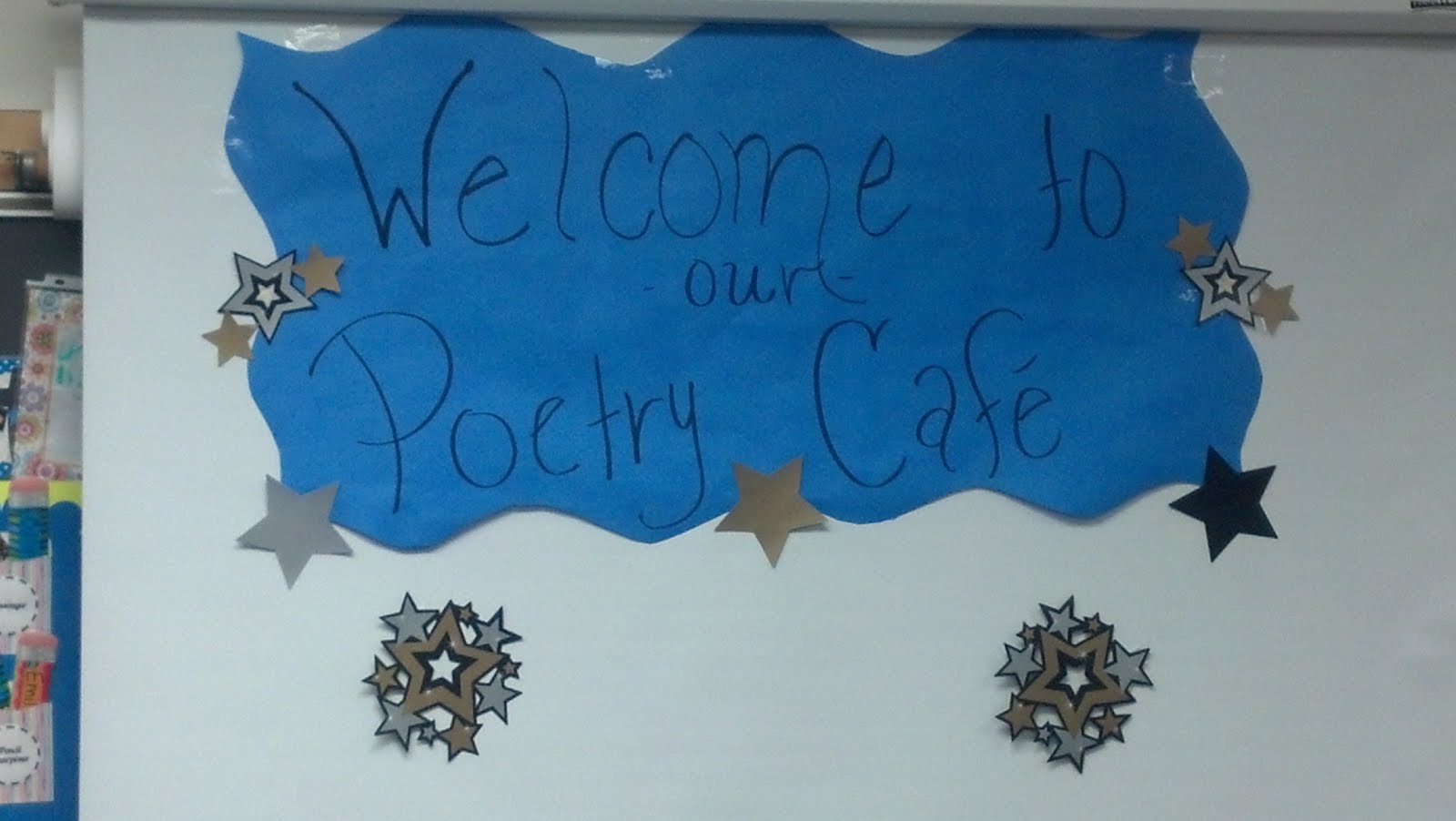
Today was my last Poets' Tea of the school year.
I received lots of nice comments from parents, hugs from the Northfield Third Graders, and this tanka:
Mrs. Poems
She has short brown hair
She dresses pretty and kool
She helps people understand poetry
I like her as my poetry teacher
I wish there were more people like Mrs. Poems
It came with a cute manga-type drawing, in which I am wearing a stylish black mini-dress and sporting side-swept bangs that coyly cover one eye.
Thanks, Northfield! Can't wait until next year.
Friday, March 12, 2010
Poetry Friday: A Chapbook!
Poetry Friday friends, I'm so excited to share my news with you!
My chapbook, Mountain, Log, Salt and Stone, has won the Clarinda Harriss Poetry Prize, sponsored by Baltimore's CityLit Project.
The book comes out for National Poetry Month. Here is the press release, which includes the ISBN.
The final judge was poet, physician and all-around Renaissance man Michael Salcman. After the contest was over, Michael generously helped me to fine tune my manuscript. I feel blessed to call him a mentor. What a gift!
Michael is a master of ekphrastic poetry. Today, I'm sharing one of his "Eight Eakins Portraits" -- "Portrait of Walt Whitman." It appears in Michael's book, The Clock Made of Confetti (which has a lovely series of ekphrastic poems).
PORTRAIT OF WALT WHITMAN (1887-1888)
You see me now as the fierce friend of my final years
saw me; though he painted me resting, I'm not at rest
my brain whirls with continents. My eyes are open,
thought death is limned in me like sweet drunkenness
and my cheeks remain ruddy. Around my head
and lips the gray hairs billow like wisps of smoke
or a final breath. On my shoulder, a flat collar flares
a white epaulet -- none owned by Falstaff nor painted
by Hals was ever finer though I'm hardly a gay toper
like them. Sorely vexed when first we met, he wrote
"My honors are misunderstanding, persecution and neglect,
enhanced because unsought." I think he caught me dreaming
of his resignation and bitterness; I never liked this likeness
much (not that I told him).
Posted with permission of the poet.
Don't you love how Whitman's "brain whirls with continents"?
If you're in the Baltimore area, mark April 17 on your calendar. It's the CityLit Festival -- a day long, free event -- at the Enoch Free Pratt Library.
There are readings by poets, novelists, children's author Patrick O'Brien, and spoken word performers. The full line-up is here. In the afternoon, Michael Salcman is hosting a reading with me and Maryland Poet Laureate Stanley Plumly.
I hope you can make it! I'll need a big cheering section to calm my nerves.
Have a wonderful Poetry Friday, everyone. Our host is Becky at Becky's Book Reviews. Enjoy!
My chapbook, Mountain, Log, Salt and Stone, has won the Clarinda Harriss Poetry Prize, sponsored by Baltimore's CityLit Project.
The book comes out for National Poetry Month. Here is the press release, which includes the ISBN.
The final judge was poet, physician and all-around Renaissance man Michael Salcman. After the contest was over, Michael generously helped me to fine tune my manuscript. I feel blessed to call him a mentor. What a gift!
Michael is a master of ekphrastic poetry. Today, I'm sharing one of his "Eight Eakins Portraits" -- "Portrait of Walt Whitman." It appears in Michael's book, The Clock Made of Confetti (which has a lovely series of ekphrastic poems).
PORTRAIT OF WALT WHITMAN (1887-1888)
You see me now as the fierce friend of my final years
saw me; though he painted me resting, I'm not at rest
my brain whirls with continents. My eyes are open,
thought death is limned in me like sweet drunkenness
and my cheeks remain ruddy. Around my head
and lips the gray hairs billow like wisps of smoke
or a final breath. On my shoulder, a flat collar flares
a white epaulet -- none owned by Falstaff nor painted
by Hals was ever finer though I'm hardly a gay toper
like them. Sorely vexed when first we met, he wrote
"My honors are misunderstanding, persecution and neglect,
enhanced because unsought." I think he caught me dreaming
of his resignation and bitterness; I never liked this likeness
much (not that I told him).
Posted with permission of the poet.
Don't you love how Whitman's "brain whirls with continents"?
If you're in the Baltimore area, mark April 17 on your calendar. It's the CityLit Festival -- a day long, free event -- at the Enoch Free Pratt Library.
There are readings by poets, novelists, children's author Patrick O'Brien, and spoken word performers. The full line-up is here. In the afternoon, Michael Salcman is hosting a reading with me and Maryland Poet Laureate Stanley Plumly.
I hope you can make it! I'll need a big cheering section to calm my nerves.
Have a wonderful Poetry Friday, everyone. Our host is Becky at Becky's Book Reviews. Enjoy!
Thursday, March 11, 2010
Anything You Want
Yesterday, I gave the Northfield third graders magic pockets. They could put anything in the pocket -- the only limit was their own imaginations. (Find the lesson, model poem and poetry prompt here.)
I love using this writing exercise, because it often reveals what a child is passionate about.
For Sarah S, it's art.
I have a jacket,
a jacket made of pockets. In pocket
199, I have a magic art
studio. It is stacked and
packed with art! Art
supplies, famous artists and
Ms. Kramer! I can take
them out and they
can teach me art!
I would LOVE that
because I LOVE
Art. I would make
a plaster sculpture
that would last a
MILLION years!
Adam L's passion is sports. I love this magic football helmet, that grows with him.
I have a jacket,
a jacket made of pockets.
In pocket 86 I have
a magical football helmet.
It fits on my head
no matter how big my head gets.
It is a Ravens helmet with stripes.
It includes a face mask.
My football helmet makes me throw
super far.
I set world records.
I am better than any pro.
The Ravens invite me
onto their team.
If you're trying this lesson, and your students are stuck, try this frame:
First three lines:
"I have a jacket,
a jacket made of pockets.
In pocket ___, I have a..."
Followed by:
a description of what is in the pocket, use all five senses if you can.
Then:
what does the object do?
Finally:
Why do you want this thing? You can begin this section with, "I take it out when I..."
Tomorrow is Poetry Friday. I have a BIG announcement to share! See you then.
I love using this writing exercise, because it often reveals what a child is passionate about.
For Sarah S, it's art.
I have a jacket,
a jacket made of pockets. In pocket
199, I have a magic art
studio. It is stacked and
packed with art! Art
supplies, famous artists and
Ms. Kramer! I can take
them out and they
can teach me art!
I would LOVE that
because I LOVE
Art. I would make
a plaster sculpture
that would last a
MILLION years!
Adam L's passion is sports. I love this magic football helmet, that grows with him.
I have a jacket,
a jacket made of pockets.
In pocket 86 I havea magical football helmet.
It fits on my head
no matter how big my head gets.
It is a Ravens helmet with stripes.
It includes a face mask.
My football helmet makes me throw
super far.
I set world records.
I am better than any pro.
The Ravens invite me
onto their team.
If you're trying this lesson, and your students are stuck, try this frame:
First three lines:"I have a jacket,
a jacket made of pockets.
In pocket ___, I have a..."
Followed by:
a description of what is in the pocket, use all five senses if you can.
Then:
what does the object do?
Finally:
Why do you want this thing? You can begin this section with, "I take it out when I..."
Tomorrow is Poetry Friday. I have a BIG announcement to share! See you then.
Wednesday, March 10, 2010
Leaping off the Cliff
As writers, sometimes we have to leap off the imaginative cliff and trust that something will be there to lift us. A magical cloud? A boy with wax wings? A talking bird that wants a strand of our hair for its nest?
My last workshop with the Northfield third graders was all about imaginative leaps.
We use the fabulous Calef Brown's poem, "Eliza's Jacket," as a model. (Go to youtube to find some of Brown's poems set to music. They're so much fun!)
The poem is deceptively simple, but get kids talking about why Brown said Eliza has "melted snow" in her pocket instead of "water," and you'll be amazed at their insights.
For one day, I let students have a jacket like Eliza's. The pockets hold anything their imaginations can create. Two rules -- no money (just write what you want) and no wishes or creatures who grant them (again, just write what you want.)
Here is Michael D's cerebral response:
I have a jacket,
a jacket made of pockets.
In number 197,
I have a miniature brain.
It has 9,999 IQ,
and it goes into my head.
When it does,
I don't have to think.
So when I have a test,
I get an A plus.
And I won't have to do things like
take days to invent a time machine,
and my Reading homework too.
I'd get invited to somewhere
with people asking me how I'm so smart.
I'd live a great life,
with luxury at every place.
Quentin B's poem is tactile and powerful:
I have a jacket,
a jacket made of pockets.
In pocket 3,000 I have
a magic tornado that's the
size of a skyscraper.
It makes the sound
of an airplane zooming
in the air. If someone
is being mean to you
the tornado will
suck them up and
trap them in my
pocket until I
want to take
them out.
I'm fond of magical clothing. Once a class and I invented a magic coat that changed with the weather. It grew fur in the winter, air conditioned in the heat, and at night it could glow in the dark.
If you try this prompt in the classroom, the Northfield teachers and I developed a fun craft to go with it. Write the poems on a square of white paper. Then give each child a blue "pocket" to decorate. Post the pockets with the poems loose inside. Kids and parents love lifting the poems out to read. Enjoy!
My last workshop with the Northfield third graders was all about imaginative leaps.
We use the fabulous Calef Brown's poem, "Eliza's Jacket," as a model. (Go to youtube to find some of Brown's poems set to music. They're so much fun!)
Eliza’s Jacket
Eliza has a jacket,
a jacket made of pockets.
The pockets all have numbers,
numbers on the jacket pockets.
Pocket three has bees inside,
sixteen contains their honey.
Number eight has cracker crumbs
and wads of Turkish money.
Twenty-three is filled with gum
(all unchewed I hope),
while right next door in twenty-four
is kept a one-inch piece of rope.
Thirteen is packed with useless facts,
and four has melted snow.
What’s in the rest you’ll have to guess.
It’s not for us to know.
Used with the author’s permission.
For one day, I let students have a jacket like Eliza's. The pockets hold anything their imaginations can create. Two rules -- no money (just write what you want) and no wishes or creatures who grant them (again, just write what you want.)
Here is Michael D's cerebral response:
I have a jacket,
a jacket made of pockets.
In number 197,
I have a miniature brain.
It has 9,999 IQ,
and it goes into my head.
When it does,
I don't have to think.
So when I have a test,
I get an A plus.
And I won't have to do things like
take days to invent a time machine,
and my Reading homework too.
I'd get invited to somewhere
with people asking me how I'm so smart.
I'd live a great life,
with luxury at every place.
Quentin B's poem is tactile and powerful:
I have a jacket,
a jacket made of pockets.
In pocket 3,000 I have
a magic tornado that's the
size of a skyscraper.
It makes the soundof an airplane zooming
in the air. If someone
is being mean to you
the tornado will
suck them up and
trap them in my
pocket until I
want to take
them out.
I'm fond of magical clothing. Once a class and I invented a magic coat that changed with the weather. It grew fur in the winter, air conditioned in the heat, and at night it could glow in the dark.
If you try this prompt in the classroom, the Northfield teachers and I developed a fun craft to go with it. Write the poems on a square of white paper. Then give each child a blue "pocket" to decorate. Post the pockets with the poems loose inside. Kids and parents love lifting the poems out to read. Enjoy!
Tuesday, March 9, 2010
Opposites Poems
Writing opposites poems is one of the best ways to teach young one stanzas. My third grade students at Northfield Elementary are revising their poems, getting ready for Friday's Poets' Tea.
An aside -- stanza is the Italian word for room. When you read a poem, imagine it's like walking through the rooms of a house. Each stanza is a different room, with its own color scheme and knick-knacks, but still part of the whole home.
Opposites come in pairs, so our opposites poems have two parts -- two stanzas. The poetry comes from which details the author chooses, as Jack does with his amazing sensory imagery in "Day and Night."
Day and Night
by Jack S.
In the day, the sun is bright
and the birds soar gracefully, high in the sky.
As I look up in the air, the clouds look like ships battling.
The city is busy. The shopping spree is on.
There are so many cars on the road, I can barely get across.
The moon is so bright, shining down upon my little head.
Bats fly brave out in the dark, open night.
The stars in the sky reflecting off my eyes.
Not a word is heard in my ears as the city grows quiet.
The roads are scarce, not a car in sight.
As you can see, day and night are so different, yet both have
one thing in common. They are both so pretty.
You can find my full lesson on opposites poems here. The model poem is Elizabeth Coatsworth's "Swift Things Are Beautiful." Here's a nice clip of a child reading the poem.
In looking for a photo of bats, I came across these guys all wrapped up in little sleeping bags. Is that the cutest? You can read about these orphaned night-flyers and the Queensland animal shelter that rescued them here.
If you'd like more opposites poems to share with children, check out Donald Hall's book, "I Am the Dog, I Am the Cat." There are also several fun versions of Richard Wilbur's opposites/riddle poems.
Tomorrow, I'll be posting Pocket Poems by Northfield third graders. Be prepared -- we'll be letting our imaginations run wild!
An aside -- stanza is the Italian word for room. When you read a poem, imagine it's like walking through the rooms of a house. Each stanza is a different room, with its own color scheme and knick-knacks, but still part of the whole home.
Opposites come in pairs, so our opposites poems have two parts -- two stanzas. The poetry comes from which details the author chooses, as Jack does with his amazing sensory imagery in "Day and Night."
Day and Night
by Jack S.
In the day, the sun is bright
and the birds soar gracefully, high in the sky.
As I look up in the air, the clouds look like ships battling.
The city is busy. The shopping spree is on.
There are so many cars on the road, I can barely get across.
The moon is so bright, shining down upon my little head.
Bats fly brave out in the dark, open night.
The stars in the sky reflecting off my eyes.
Not a word is heard in my ears as the city grows quiet.
The roads are scarce, not a car in sight.
As you can see, day and night are so different, yet both have
one thing in common. They are both so pretty.
You can find my full lesson on opposites poems here. The model poem is Elizabeth Coatsworth's "Swift Things Are Beautiful." Here's a nice clip of a child reading the poem.
If you'd like more opposites poems to share with children, check out Donald Hall's book, "I Am the Dog, I Am the Cat." There are also several fun versions of Richard Wilbur's opposites/riddle poems.
Tomorrow, I'll be posting Pocket Poems by Northfield third graders. Be prepared -- we'll be letting our imaginations run wild!
Subscribe to:
Posts (Atom)


