THE LAST FIFTH GRADE OF EMERSON ELEMENTARY

THE LAST FIFTH GRADE OF EMERSON ELEMENTARY
April 12, 2016

Saturday, July 3, 2010

Summer Reads: Single Voice Flip

I know for some people ALA is  all about free ARCs...

but one conference perk nobody talks about -- great eavesdropping!

I picked up a book published by Annick Press because I overheard one of the editors raving about it.

Annick has a five-book series called "Single Voice." It's a cool concept. Each book has two YA short stories (printed in super-huge font). The stories are back-to-back, so when you're done reading one, you flip the book over for the second story. The series seems like a good fit for reluctant teen readers.

I read "Nothing but Your Skin" by Cathy Ytak, with a B-side, "The Pool Was Empty," by Gilles Abier. Both stories are YA for sex, language and themes. Both were translated from French.

What was your overall impression of the book?

The two stories were quick reads (less than an hour each). Don't look for the depth of a novel here. They are definitely short stories where a teen tells the reader about one life-changing event.

The story in one sentence?

  • "Nothing but Your Skin" -- a developmentally disabled girl, whose parents don't see her as a whole person, gets caught having sex.

  • "The Pool Was Empty" -- after being acquitted of her boyfriend's murder, shallow teen Celia examines their relationship.

Who were your favorite characters and why?

Lou, the narrator of "Nothing but Your Skin" is the most fully drawn character in both stories. I liked that she was an unreliable narrator, because of her disability (she doesn't share her specific diagnosis). Lou's understanding of her parents' limited and limiting view of her is heartbreaking.

What were your favorite parts of the story?

Both stories open with big drama ("Skin" -- the lovers getting caught, "Pool" -- the court room), then retrace how the teens ended up in trouble. That tactic worked well for both pieces. I also loved the setting of "Skin," especially the characters' sexual encounter on a frozen lake's surface -- beautiful.

What did you like about the cover?

The whole flip concept is appealing. Teens will feel they are getting two for the price of one. What they're actually getting is two strong short stories, padded by large font and clever marketing.

Would you recommend to a friend? What would you say?

This one is for upper high school. I have a young friend going into 9th grade. She'd love both stories, but I wouldn't want to be the one handing this book to her -- too racy, with f-bombs. Still, "Nothing but Your Skin" in particular offers a lot to think about. I'd like to see that one expanded into a novel.

SCORE
"Nothing but Your Skin" Three Scoops (expanded to novel length, it could be a Sundae), "The Pool Was Empty" One Scoop (with sprinkles).

Overall: Two and a half scoops.


Review Cheat Sheet
Empty Cone – Didn’t like it.
One Scoop – It was okay.
Two Scoops – Pretty good.
Three Scoops – Great book.
Sundae – I want to read the whole series. Now.

Friday, July 2, 2010

5 Questions for Jeannine Atkins (Part 2)

More of my interview with author Jeannine Atkins about her book Borrowed Names: Poems about Laura Ingalls Wilder, Madam C.J. Walker, Marie Curie and Their Daughters. Part 1 is here.

Jeannine and I have discussed the first two sections of the book, poems about Laura Ingalls Wilder and Rose Wilder, and Madam C.J. Walker and her daughter A'Lelia. The third portion explores the relationship between Marie Curie and her daughter Irene.

4. In the Marie Curie and Irene Joliot-Curie section, there is a poem called “Between Gardens.” Irene is both fascinated by “the pale blue glow from bowls of crystals” and jealous of the attention her parents give their experiments.

How did you plan this series of poems to show Irene’s shift from resentment of her parents’ work, to becoming a Nobel Laureate for her own scientific work? I’m wondering about plotting with poetry.

The plotting with poetry was fun, as I began with that structure – here’s a daughter who won the same amazing award bestowed upon her mother – and wondered how she got there.

In Irène’s letters to her absent mother, her need for her reads like a scientific fact that she expresses clearly and directly. It’s a different tactic than the more typically feminine one her younger sister chooses, hoping to bring loved ones closer not by stating facts but through charm, clothing, music, and kindness bordering on self-sacrifice. As a child, Irène did resent her mother’s distance, but she never blamed her work. 

In “Without School Bells,” I wrote about how Irène needs “to comprehend the laws of radiance, reflection, refraction./Every question and answer binds her/ to the one world her mother loves.”

So she became closer to, or maybe sought to understand, her mother through the science. Irene is the only daughter in your book with a sister. It's interesting how Curie's daughters (pictured with Curie below) used different coping skills to handle their mother's focus on her work.


5. How has working on this book – and now, seeing how readers respond to it – enriched you as a poet and writer? What did you learn in the process?

It’s opened up a world to me, and I’m grateful for every reader who’s found something in my words. I still tend to think of myself as more of a story-teller than a poet, and of course these poems are held together with narrative arcs. 

The imagery and pace of poetry, the way I could choose over and over where to begin and end a section, and let that hold some power, seemed the best way to tell the stories of these women’s lives, leaving small clues about how they connected while taking their own particular courses. I like the process of building up, then taking away. Sorting through all the details of a life to find ones that seem to truly speak. Looking for, and making, patterns from the small things that might be found on a kitchen table or a porch.

Now I’m working hard – trimming, trimming, trimming, looking for the essential words that will show an era when writing began. I’m showing the surfaces of a different language, clothing, vehicles, religion, and politics, and drawing connections through the same sky and similar hearts.


It's quite an achievement. I also appreciate that you did not force comparisons between the three mother-daughter pairings. Instead, the reader creates his or her own threads of understanding among these three distinct stories.


Jeannine, thanks again for visiting. It's been great talking poetry with you!
 

Poetry Friday: 5 Questions for Jeannine Atkins (Part 1)

Have you adjusted to summer yet? My kids have been off school for just over a week. Our little annoyances with one another (like my 13-year-old constantly pestering for more XBox time) seem more annoying at the beginning of summer. Then we learn to cope with the shift in our relationships and settle into summer-normal.

I'm thinking about parent-child relationships today because author and Poetry Friday blogger Jeannine Atkins is visiting. Hi, Jeannine!

Jeannine's book, Borrowed Names: Poems about Laura Ingalls Wilder, Madam C.J. Walker, Marie Curie and Their Daughters is a trio of historical relationship studies -- all in verse. Look at the *display bling* Borrowed Names had at ALA last weekend.


That's a rainbow of stars!

Jeannine discovered that all three famous women she profiles were born in the same year -- and all three had daughters who influenced their own professional lives. So Jeannine began a journey of research, writing and finally a wonderful book (2010, Henry Holt). I can't wait until my daughter (now 10) is old enough to read and discuss Borrowed Names.

1. You wrote a blog post for the journal Hunger Mountain  about beginning this book project in prose, then shifting to poetry. How did poetic form open up these mother-daughter stories for you?

I love the way that line breaks in poetry can emphasize words in the cutting way we’ve practiced as half-grown daughters, letting phrases turn sharp as an angle of an eyebrow, the spin of a turning back. And as a mother of a teen, I grew practiced in editing, thinking: Is this a thought I need to say? Moving the stories to poetry added some of silence’s tension, the way it does in a conversation, especially one between people who love each other, but also often crave a space away.

Believe me, this is also true for mothers and half-grown sons. I like the point about the tensions poetry can create with the silence of line breaks and spaces between stanzas. It's a way of listening to the poem's voice.

2. When you went back to Laura Ingalls Wilder’s books, what did you find there that felt poetic? How did her (and daughter Rose’s) writing style inform your poems about them?

I love the Little House books, but they feel more sturdy to me than spare as they move through the premise that people can and do go on… and on. Which has its own thrill, but it’s not so poetic. The connections and distance between the novels and the lives they were based on most inspired me, just as the difference between Louisa May Alcott’s real life and the somewhat idealized Little Women moved me to write a novel for middle readers called Becoming Little Women.

I was surprised to learn from your book how involved Rose was in the writing of her mother's books. There must be some interesting surprises for Alcott fans in Becoming Little Women.

3. One of my favorite poems in the book is “Pieces” – about Madam C.J. Walker and her daughter A’Lelia. The poem asks how A’Lelia can “bear to be the girl/ who demands so much giving up” from her mother. The adolescent daughter seems to be criticizing how she treats her mother, but is unable to stop herself. That feels very modern.

Can you talk about blending historical facts with moments like this – where we could be talking about a mother and daughter of 2010? How did writing poems help you weave together history and the rawness of these women’s relationships?

It’s always a question about how much of the present to bring to the past, but I tend to believe that while people may have dressed differently, read differently, and sat on different furniture, there’s more that remains the same than has changed.

Reading books written in the nineteenth century, we find more sentimentality about the mother- daughter relationship, as well, of course, about much else, such as the true labor of child-bearing or the difficulties of marriage. Good manners are more present in depictions of family life, and some habits must have gone deep. Daughters probably did feel a keener sense of dependency on mothers who might be their midwives or at least likelier to be neighbors.

But the daughters in this book came of age on the cusp of modern period. Virginia Woolf wrote, “On or about December 1910 human character changed.” Of course her tone is slightly arch, but the daughters in Borrowed Names lived through a time when the first world war brought enormous fear and tragedy, the suffrage movement and fights for civil rights were strengthened, definitions of what makes good art and music widened, and science was becoming increasingly rooted in worlds visible only to specialists. These daughters were going to live in quite different worlds than the ones their mothers had grown up in, and there were bound to be struggles as they found their places alone and together.

That's a good point about the daughters being aware they would inhabit different worlds than their mothers. A'Lelia Walker and Irene Joliot-Curie must have been particularly attuned to this, because they saw their mothers creating some of the changes you mention -- civil and women's rights, entrepreneurship, scientific progress.

More of my interview with Jeannine later today. While you're waiting for Part 2, check out more Poetry Friday offerings at Amy's blog, The Poem Farm. Or , go directly to Jeannine's awesome blog.

Tuesday, June 29, 2010

50 State Tour: South Dakota

Our tour of the states poets' laureate is finally hitting the big 4-0 with South Dakota. It became the fortieth state on November 2, 1889.

The Mount Rushmore State has some strange laws on the books, according to www.dumblaws.com.

No horses are allowed into Fountain Inn unless they are wearing pants.
     Apparently, all other South Dakota inns welcome naked horses.

It is illegal to lie down and fall asleep in a cheese factory.
     I'm guessing, this way everyone will know you have been overcome by the cheese aroma and you have, in fact, fainted.

If there are more than 5 Native Americans on your property you may shoot them.
     I can't even get my brain around this one. How do laws like this survive?
The wording of South Dakota's law regarding its poet laureate should go on the www.dumblaws.com list.  The laureate is "appointed by the Governor to serve during the pleasure of the Governor." Yowza. I don't think I'd want to write that poem.

Here is South Dakota Poet Laureate David Allen Evans, with his poem, "Neighbors." This poem touched a nerve for me. I'll explain why after you read it.

Neighbors

by David Allen Evans 

They live alone
together,
   
she with her wide hind
and bird face,
he with his hung belly
and crewcut.
   
They never talk
but keep busy.
   
Today they are
washing windows
(each window together)
she on the inside,
he on the outside. 
The poem has a great ending. Read it at the Poetry Foundation.

Funny -- South Dakota law says nothing about Windex fights. But maybe it should. Maybe there should be a law against locking your fighting children in a small bathroom. Because one of them is going to get sprayed in the face with Lysol. Just sayin'.

Monday, June 28, 2010

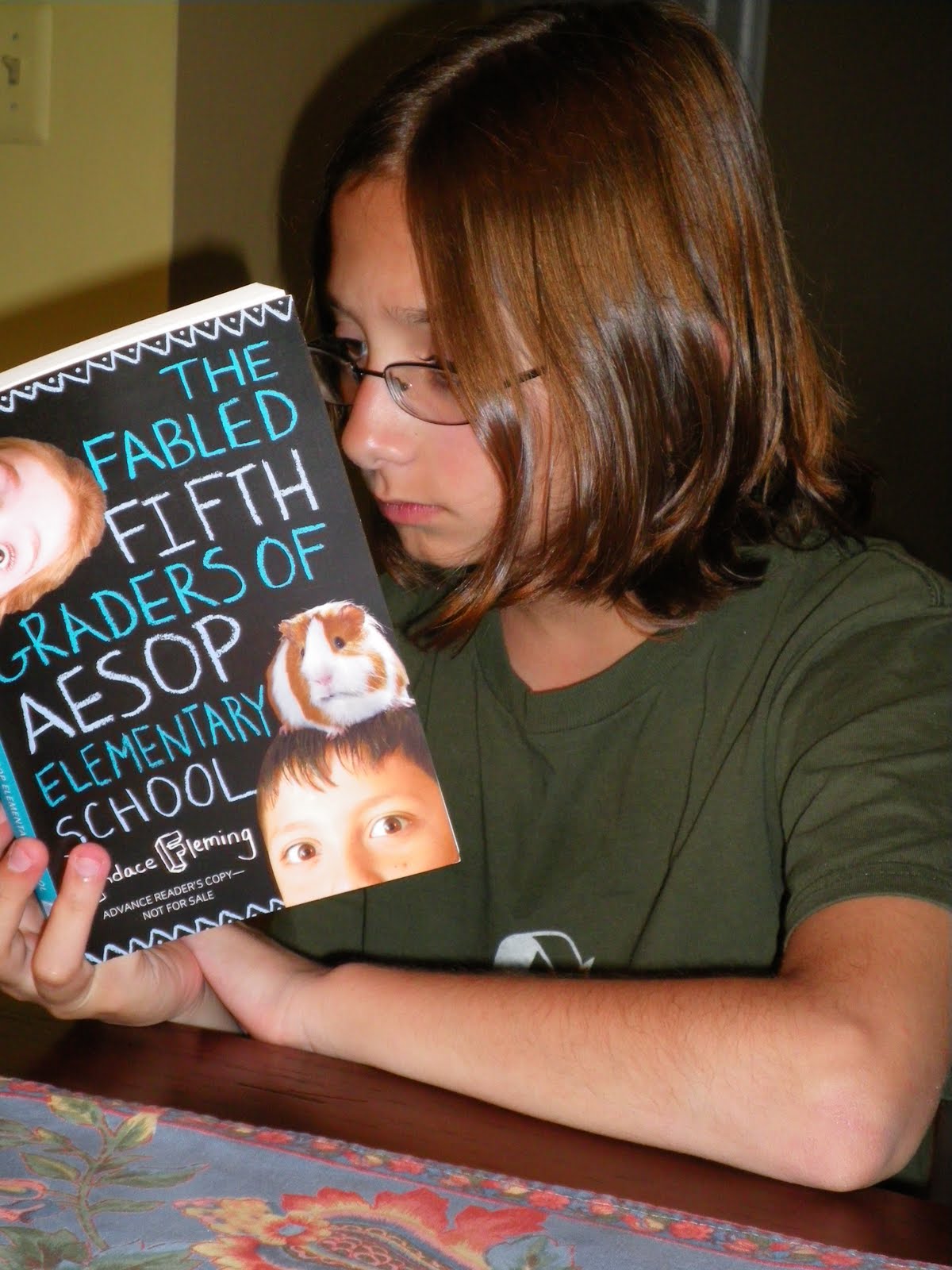
Summer Reads: The Fabled Fifth Graders of Aesop Elementary School

One of the ARCs I picked up at the ALA convention was The Fabled Fifth Graders of Aesop Elementary School, by Candace Fleming.

I do poetry workshops and write for fifth grade, so it was a must-have book.

However, the minute I got home from the convention, my 10-year-old daughter snagged it. "I'm reading this one first!" she said. I gave in. After all, she's the rising fifth grader in the house.


Here is Miss J's review.

The Fabled Fifth Graders of Aesop Elementary School, by Candace Fleming.
(ARC provided by Random House Kids, pub date 8/2010)

Overall: It was really funny because there were a lot of parts that definitely wouldn't happen in an every day type of school. It was very strange and creative. It was also funny because most of the kids' names had something to do with the way they acted or what they were like.

Story in one: It's about a bizarre fifth grade class that has many funny and awkward adventures.

Fave characters: My favorite character was probably Rose Clutterdorf. I liked her because she was a very bright character, but she always managed to smear and smudge almost everything she owned -- including her desk and clothes.

Fave part of story: The other teachers are in the teachers' lounge when all of a sudden and man and his class come in wearing Aztec headdresses. This is the main class and their teacher, Mr. Jupiter. He is very strange and has been through many adventures all over the world and has collected a lot of stuff.


Another favorite part was when Mr. Jupiter brought in a big box and inside of it was their new class pet. The box was really big, so the kids thought that the pet must be really big and amazing. They were hoping for a unicorn, a pink headed duck, or at least a giant squid.

Cover: My favorite part about the cover is the boy and he has a guinea pig on his head. I like the guinea pig. I like that the title is the Fabled Fifth Graders of Aesop Elementary because Aesop wrote a lot of fables, so it makes sense but it's also very funny.

Recommend it to a friend?: Yes. I really enjoyed this book and anyone who has a good sense of humor, I would recommend it to.

SCORE: Sundae!


Our Summer Reads Scoring System
Empty Cone: Didn't like it
One Scoop: It was okay.
Two Scoops: Pretty good.
Three Scoops: Great book!
Sundae: I want to read the whole series. Now.

Sunday, June 27, 2010

ALA & ARC Reviews: Amulet

Yesterday, my friend Jen (on extended maternity leave from Howard County library), her 13-year-old daughter and I headed to the American Librarians Association conference in Washington, DC.

In the name of literature, we braved crowds on the Metro headed for DC's Caribbean Festival. It was totally worth it.

For $25 we bought floor passes for the ALA exhibit hall. The publishers are incredibly generous -- giving out ARCs (Advanced Readers Copies), posters and other swag to librarians and attendees. The giveaways help build advance press and sales for soon-to-be-published books.

One editor staffing the Random House booth even took the time to explain my friend's daughter exactly what an ARC is. And many editors helped point out novels-in-verse (for me to share with schools I visit) or books they fell in love with themselves.

The kids and I have our summer reading cut out for us. But I'm making them (and me) earn these books. My 13-year-old son, 10-year-old daughter and I will be reviewing the ARCs I brought home.

Here's our Summer Reading scoring system:

Empty Cone – Didn’t like it.


One Scoop – It was okay.


Two Scoops – Pretty good.


Three Scoops – Great book.


Ice Cream Sundae – I want to read the whole series. Now.


My son, a rising 8th grader, is up first with his review of a graphic novel.

Amulet Book Three: The Cloud Searchers by Kazu Kibuishi.
(Uncorrected Proof provided by Graphix, Scholastic, pub date 9/2010)

Overall: Interesting, since it was the third book, I really had no clue what was going on, but as I kept reading I basically got the picture. I liked the magicky part of it and the whole future era/otherworld airship thing, with animals (pets in our world) that talk and help you along in the story or try to destroy you. The magic part makes it fun.

Story in one: This group --  a human family, a fox, a robot, two elves and two cats -- tries to get to a flying city, hoping to find people who can help them save their world from being destroyed by evil elves.

Fave characters: The human girl because I can relate to her most, because I have a younger sister (and she has a younger brother).

Fave part of story: I liked the part when the bad elves were chasing them out of the city because it was exciting. There was action and stuff.

Graphics: They looked real.

Recommend it to a friend?: The whole graphic novel thing is pretty cool and most of my friends like graphic novels.

SCORE: I call it a Sundae!
 More ARC reviews -- and hopefully, more sundaes -- to come.