THE LAST FIFTH GRADE OF EMERSON ELEMENTARY

THE LAST FIFTH GRADE OF EMERSON ELEMENTARY
April 12, 2016

Friday, July 29, 2011

Poetry Friday: Alcott's Orchard House

Last week, my family was in Concord, Mass. At the top of my to-do list was taking my daughter (11) to Louisa May Alcott's home, Orchard House.

I learned more during this house tour than I can share in one post. We weren't allowed to take pictures inside the house, so here are some highlights:

  • The fold-down desk where Alcott wrote Little Women in just three months -- it was made by her father. No surprise. Alcott's writing supported the entire family, something education reformer and transcendentalist Bronson Alcott had never been able to do. A little door in the wall above the desk opens. Inside, you can see Bronson Alcott's pencilled note on the wooden beam of the house.

  • I was taken with the windows next to Alcott's writing desk. Each pane of glass was decorated with a dried, pressed Queen Anne's Lace blossom. Look closely at this photo taken from outside and you may see them.

  • May's room (Amy, in Little Women), is covered in "graffiti," her early artwork. Louisa became the best-selling American author of the 1800s after Little Women was published. She put May through art training. One of May's paintings won a spot in the prestigious Paris Salon, beating out Mary Cassatt.
La Negresse 

Alcott lived in this house in her twenties, but set Little Women here. I loved finding small details, like a chore-list for the girls in the master bedroom.


Before Little Women made it big, Alcott wrote poetry, pieces for magazines, and pulp fiction under a pseudonym.

In researching her poetry, I found, "Thoreau's Flute." Henry David Thoreau was one of Bronson Alcott's best friends and helped home school the Alcott children. Walden Pond is nearby -- another place to visit next trip.

I also loved, "A Little Bird I Am." For me, this poem speaks to the frustrations of Alcott's life -- a father who put his ideals before his family's needs, being a female author in the 1800s (she was passionate about being a "literary spinster"), and poor health after serving as a Civil War nurse.

But the poem I am sharing is "A Song from the Suds," about Washing Day. Like Louisa, "I wish we could wash from our hearts and our souls/ the stains of the week away."

A Song from the Suds

Louisa May Alcott

Queen of my tub, I merrily sing,
While the white foam raises high,
And sturdily wash, and rinse, and wring,
And fasten the clothes to dry;
Then out in the free fresh air they swing,
Under the sunny sky.
I wish we could wash from our hearts and our souls
The stains of the week away,
And let water and air by their magic make
Ourselves as pure as they;
Then on the earth there would be indeed
A glorious washing day!
Along the path of a useful life
Will heart's-ease ever bloom;
The busy mind has no time to think
Of sorrow, or care, or gloom;
And anxious thoughts may be swept away
As we busily wield a broom.
I am glad a task to me is given
To labor at day by day;
For it brings me health, and strength, and hope,
And I cheerfully learn to say-
'Head, you may think; heart, you may feel;
But hand, you shall work always!' 
  
When I read the last line, I take the word "hand" literally. Alcott wrote for up to seventeen hours each day when she was working on a book. Her right hand would get so cramped, I learned on the house tour, that she taught herself to write left-handed and would switch off.

I'm off to watch the American Masters biopic of Alcott with my daughter. Hope you enjoyed the tour!


Thanks to Kate at Book Aunt for hosting today's Poetry Friday round up.

Thursday, July 28, 2011

The Shot Heard Round the World

In two days, I'm returning to Massachusetts, where my son (14) has been doing his Sea Cadet training. We finally received a letter from him last night. The friends he's made are helping him over homesickness. A passionately picky eater, he's trying new foods. And one of the petty officers had lost his voice after just one day of training.

We stayed in the Concord area for a couple of days when we dropped my son off. It's a must-see for history/American literature lovers. We didn't have time to see everything, so I'm hoping for more Concord trips in our future.

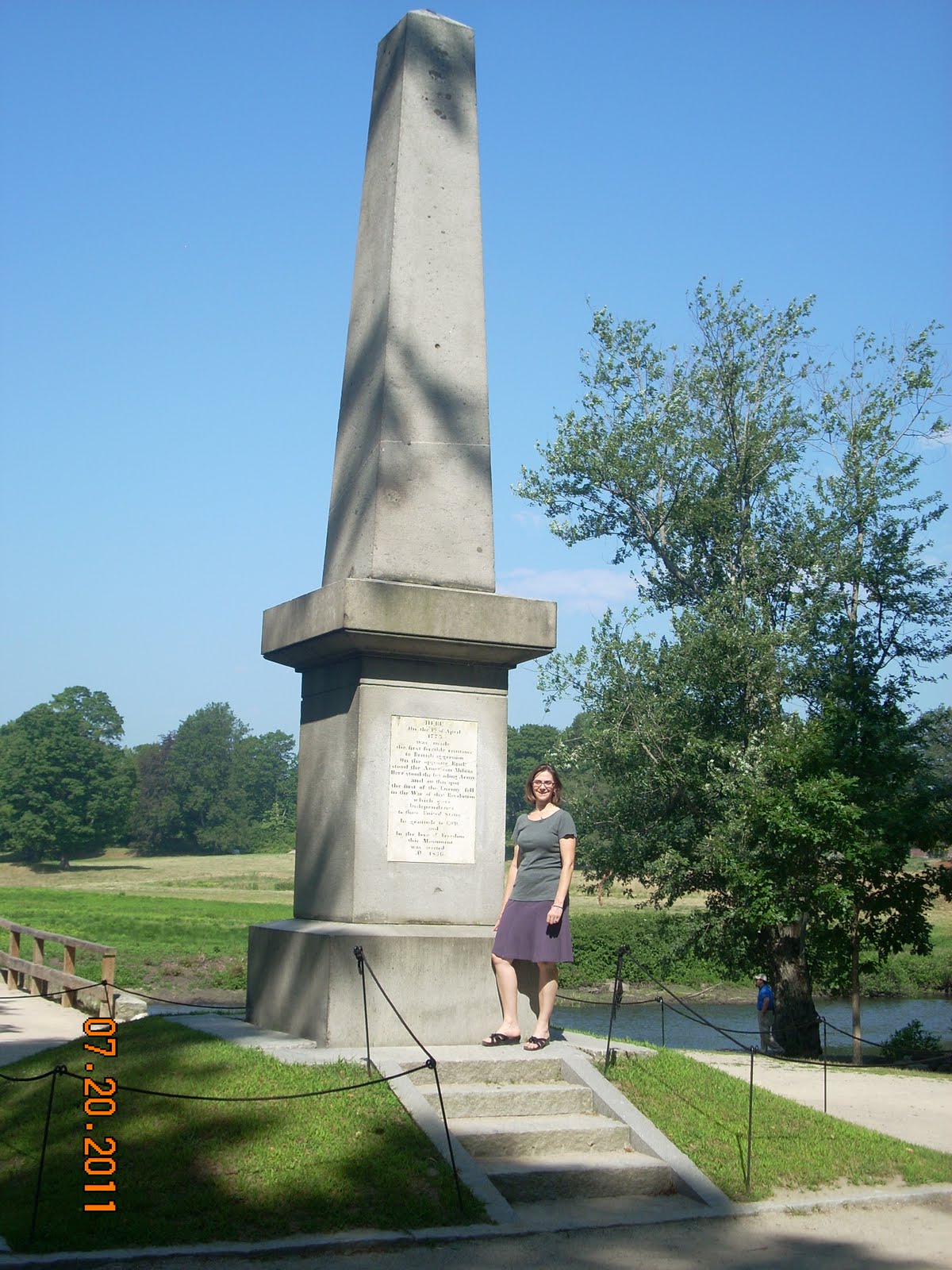
One of the things I wish my son had seen with us was North Bridge. We went on a brutally hot day -- so humid that my camera lens fogged up.


I tried to explain the significance of the bridge to my daughter (11). Meanwhile, the Schoolhouse Rocks song was playing in my head.

The British Are Coming! The British Are Coming!

by Bob Dorough

Now, the ride of Paul Revere
Set the nation on its ear,
And the shot at Lexington heard 'round the world,
When the British fired in the early dawn
The War of Independence had begun,
The die was cast, the rebel flag unfurled.

And on to Concord marched the foe
To seize the arsenal there you know,
Waking folks searching all around
Till our militia stopped them in their tracks,
At the old North Bridge we turned them back
And chased those Redcoats back to Boston town.

Read the rest or find a link to the clip on Youtube here.

We had already visited Orchard House, home of Louisa May Alcott. There, we learned that Alcott's sister May (Amy in the books), mentored Daniel Chester French, who sculpted this statue, The  Minute Man. He stands to one side of the bridge.


French went on to design the Lincoln Memorial. We also saw this memorial (on the other side of the bridge).


According to the National Center for Public Policy Research, Ralph Waldo Emerson wrote a poem "which was sung as a hymn at a July 4, 1837 ceremony to mark the completion of the Concord Monument, to immortalize the resistance of American Minutemen to British forces on April 19, 1775." The hymn is the genesis for the phrase, "The Shot Heard Round the World."

Concord Hymn

by Ralph Waldo Emerson

By the rude bridge that arched the flood,
Their flag to April's breeze unfurled,
Here once the embattled farmers stood,
And fired the shot heard round the world.

The foe long since in silence slept;
Alike the conqueror silent sleeps;
And Time the ruined bridge has swept
Down the dark stream which seaward creeps.

On this green bank, by this soft stream,
We set to-day a votive stone;
That memory may their deed redeem,
When, like our sires, our sons are gone.

Spirit, that made those heroes dare
To die, and leave their children free,
Bid Time and Nature gently spare
The shaft we raise to them and thee.

If you visit North Bridge, be sure to stop at the Visitor's Center. They have a great video-story from the show "History Detectives" about a cannon the colonists stole from the British and how it may have prompted the first battle of the revolution.

Also on site is Nathaniel Hawthorne's home, The Old Manse. We toured the home many years ago -- highly recommended.

Tomorrow, I'll bring you with me to Orchard House, setting of Little Women.

Wednesday, July 27, 2011

Parenting Teens: The Place Where We Are Right

My son is headed to high school in the fall. My daughter starts middle school. Working from home -- with them home -- this summer has put my focus on the fine art of parenting teens.

My brother's soon-to-be-four year old is increasingly independent, and stubborn about it. He wanted to know if the challenges of parenting get any better. They don't. They just change.

My family is in a place where the rules, boundaries, and lines the kids aren't allowed to cross are changing fast. As parents, my husband and I are constantly reassessing what's negotiable and where we have to stand firm. Letting go gradually is an art, and it needs constant revision.

Sometimes a poem surfaces at just the right time. Today, I found "The Place Where We Are Right," by Israeli poet Yehuda Amichai. It appears in a book for teens, Faith & Doubt: An Anthology of Poems, by Patrice Vecchione.


The Place Where We Are Right


by Yehuda Amichai, trans. Chana Bloch and Stephen Mitchell


From the place where we are right
flowers will never grow
in the spring.


The place where we are right
is hard and trampled
like a yard.


But doubts and loves
dig up the world
like a mole, a plow.

Read the rest at Tricycle Magazine. You'll have to scroll down for the poem, but if this post speaks to you, you'll want to read the article.

My son has been away at camp for the last week. Missing him has felt like love digging up our world, the rawness of his absence working in the dark. How do we teach a teen with a new-found sense of independence that flowers will never grow in the place where we are right?