THE LAST FIFTH GRADE OF EMERSON ELEMENTARY

THE LAST FIFTH GRADE OF EMERSON ELEMENTARY
April 12, 2016
Showing posts with label laura shovan. Show all posts

Thursday, May 7, 2015

In Residence: Poetry Friday Words

Words for Poetry Friday
by Laura Shovan

I share words on Poetry Friday.
Inviting words--

ONOMATOPOEIA
LYRICAL
REVISE

Everyone can see them.
You'll find them waiting for you
like the FELINE that shares your home.
She sits by the window
waiting for party guests, then--

MEOW
RUB
FURRY
FOLLOW
LAP
PURR

A GARDEN is there, in the back.
LEMONADE, to cool you off.

The words play together
when we gather for poetry.

RHYTHM
HEARTBEAT
JUICY
ALLITERATION
is at the party.

My friends the words
never want to leave.
They like to stay up
all night, talking.

Magical Michelle is hosting
Poetry Friday this week at
Today's Little Ditty

Hey, Poetry Peeps.

My third grade students are finishing up their list poems. I thought I'd write with them today. 

I'm pleased with how this lesson turned out. Since this was the first workshop of our residency, the model poem provides a frame that young writers can plug into, but still adapt to their own topics.

Check out their poems, modeled after Naomi Shihab Nye's "Words in My Pillow."

Words in My Lunchbox
by Jason Y.

I pack words in my lunchbox,
words that taste good.

Fruit by Foot
Ice cream
Popsicle

No one can see them,
but they wait for me in my
lunchbox,
like the fruits waiting
inside my lunchbox.

Peaches
Grapes
Berries

My sandwich is in there.
The words are playing
together.

Chomp
Slurp
Lick

My words are all blending
together,
but the most important
word is MUNCH.

I loved Jason's use of onomatopoeia. Sound words add an extra layer to a poem because the reader can hear the sound in addition to the word.


Words in My Garden
by Jeffrey G.

I plant words inside my garden,
words that look good –

FLOWER
LEAF
PETAL

No one can see them,
but I find them waiting for me,
Like the SEED under the surface.
No one can see them
but I know what’s under there –

WATER
ROOTS
WORMS
COMPOST
VEINS
ROCKS

Good NUTRIENTS are under there.
The words are growing together
when I am watering or planting them.

VINE
POLLEN
STEM
LAVENDER
are in my garden.

My friends the words
go to rest before I do,
but they never
go away.

Jeffrey did a great job using the idea that words are hidden inside us (from the model poem) and connecting that to the hidden workings of a garden. 


Words in My House
by Isa L.

There are words
in my house. Words that make
me happy.

NOISY
CLEAN
NEAT

No one can see them, but they’re
there.

HAPPY
EATING
DRINKING
My words get along well.

PETS
BIRD
DOG
FAMILY is in my house.

I leave my house sometimes,

but I never leave my words.

Isa's poem creates a portrait of her family, because the words she chooses characterize what life is like in her house.

In Residence will be an ongoing series this month. If you missed previous posts:

First Student Responses: "Words in My Pet Goldfish," "Words in My Bed," "Words in My Life"

Thank you to the Northfield ES community for inviting me back again this year. I appreciate having the permission to share the third graders' amazing work this month.

Readers, my third grade poets love hearing feedback from you. Please leave a comment about our list poems.

Wednesday, April 29, 2015

NPM 2015: What Are You Wearing? It's a Wrap Dress

Tomorrow, we say farewell to National Poetry Month 2015. Thanks to all of you for following what's been an amazing series on poems about clothes. Why clothes? Read this post.


National Poetry Month may be ending,
but you can eat poetry anytime.
It's as easy as opening a book.
We've looked at everything from underwear to topcoats, from rainbow skirts to muddied white sneakers. I've learned so much from all of the guest bloggers. 

Clothes -- and poems about them can:

help us express our individual style,
make us feel connected to the person the article of clothing belonged to,
represent a season, a mood, or a longing,
be descriptive of a battlefield or a shared experience between parents and children,
create a sense of comfort and warmth,
be intimate, because they are held close to our bodies in a way that few other things are.

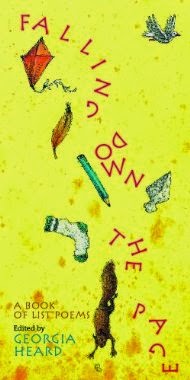
I am beginning a third grade poetry residency. This week, we worked on list poems. Naomi Shihab Nye's "Words in My Pillow" from the anthology Falling Down the Page was our model.


You'll find "Words in My Pillow"
in this anthology of list poems
from MacMillan.
Several students wrote a "Words in My Closet" poem. I decided to join them.

Words in My Closet
by Laura Shovan
after Naomi Shihab Nye

I keep words in my closet.
Words that make me look good.

CASHMERE
QUIRKY
PONCHO

No one sees them
until I put them on.
but I know what's in there--

DENIM
SNEAKERS
PURPLE
BATHROBE
STRIPES
ELEGANCE

UNDERWEAR is in there.
JELLYFISH SOCKS are in there.

The words plan outfits together
when I'm not looking.

This BLOUSE and that SKIRT
like hanging around together.
FLOWERS brighten up my closet.
RAVENS cheer "TOUCHDOWN!"
in my closet.

My friends the words
know better than I do
what fits me well.

Next week, I'll begin posting some of the third grader's list poems. They have been doing an awesome job.

Thanks again to all of the wonderful bloggers who let us into their poetry closets this month.


A skirt-full of flowers from me to you.
You'll find this and more floral skirts
at Polyvore.
ICYMI: In our poetry closet, you will find...

UPDATE: Thanks to all those who have posted a clothing poem on your home blogs and shared a link to AuthorAmok.

Read Irene Latham's ekphrastic poem "Yellow Dress."
Read about Carol Varsalona's vintage pantaloons!

And be sure to stop at Space City Scribes. The blogging team out of Houston (thus their cool name) is hosting Poetry Friday this week.


*Your suggested clothing poem prompt for Friday, May 1: Personification
If an article of clothing could talk, what stories would it tell? Whether it's a thrift store find, or an item for your closet, let your clothes speak for themselves. Has that black fedora traveled with you to Mexico? Was your daughter wearing that dress on her first day of kindergarten? Have your white Keds become mud-streaked from your hours spent in the garden? Maybe your jeans are tired of being patched and mended and would love to be retired.

Send your poems any time. I'll post original work and recommended poems on Friday.

Thursday, October 9, 2014

Poetry Friday: Lunar Eclipse


Wednesday morning, 5:15 am. My son groans when I turn on the light in the hall. My daughter begs for five more minutes of sleep. Hubby is already in the shower.

I have five minutes. Five minutes is not enough time to finish that chapter of my book (SKIN HUNGER, by Kathleen Duey) or go back to sleep. It is the perfect amount of time for checking Facebook.

Tricia at The Miss Rumphius Effect
is too busy rounding up
Poetry Friday links to check Facebook.
When you have five minutes, stop by her blog.

Facebook is where how I found out about the lunar eclipse. Friends across the country were waking their children up early and heading outside to view the Earth's shadow pass across the moon. At our house, it was just another early school day.

But I put the kettle on, got out my star-gazing binoculars, and slipped outside while everyone else went about their morning. This is what I saw...

This week's eclipse was a Blood Moon,
named for its coppery color.
Photo: EarthSky.Org 
Before everyone left for school and work, a thin line of moon -- wearing its coppery cloak -- was setting, just above the dark tree line.

Later that day, I was reading the "Poetic Asides" column in Writer's Digest. Poet Terrance Hayes -- a recent MacArthur genius award winner -- has invented a new poetic from. Using a line or lines from a favorite poem, use each word (in the correct order) as an end word in your poem. It's called a golden shovel, named for Gwendolyn Brooks' poem "We Real Cool" -- the basis for a golden shovel poem written by Hayes.

Writing Prompt: Write a golden shovel of your own.
Post your poem in the comments (making note of the poet/title of the original) and I will round up all of our golden shovels next week.

I like what Writer's Digest columnist Robert Lee Brewer says about this form. He calls it "a fun mix of found poetry and pure invention."

To capture the slow eclipse in the midst of my family's busy morning, I used Robert Louis Stevenson's "The Moon," from A Child's Garden of Verses.

Here is my golden shovel, followed by Stevenson's poem. (The words of Stevenson's poem are in gray.)

Eclipse, 5 am
by Laura Shovan

After Robert Louis Stevenson

Dark October morning, the
Earth’s shadow sweeps the Moon,
dissolves its round cheeks until the Moon has
only an icy smile. Next, it is the sliver of a
snowy owl, mostly hidden, its white face
shrunk to one silver eyebrow. Cuplike,
it holds the Sun’s reflection in its feathers. The
owl swoops down when my kitchen clock
strikes six, finds its roost below the horizon. In
moments, sleepers will tumble down the
stairs, their school shoes clicking in the still-dark hall.


The Moon
by Robert Louis Stevenson

The moon has a face like the clock in the hall;
She shines on thieves on the garden wall,
On streets and fields and harbour quays,
And birdies asleep in the forks of the trees.

The squalling cat and the squeaking mouse,
The howling dog by the door of the house,
The bat that lies in bed at noon,
All love to be out by the light of the moon.

But all of the things that belong to the day
Cuddle to sleep to be out of her way;
And flowers and children close their eyes
Till up in the morning the sun shall arise.


Tuesday, August 5, 2014

Summer Reads: Chapter & Verse (The Impossible Knife of Memory)

2014 has been the summer of the audio book. Between family visits, my son's college search, and driving kids back and forth to camp, we've racked up enough miles on the Mars Rover for a cross country trek.

(The kids nicknamed our red mini van "The Mars Rover" many years and over 120,000 miles ago. Because we are geeks. But more about that on Friday.)

I can only listen to Coldplay, Queen, and Temples so many times. That's why my first stop on any road trip is the local library, which has a great selection of audio books.

Recommended listening

For this edition of Summer Reads: Chapter & Verse, I'm pairing one of my road trip books with a poem. If you'd like to know more about this series -- in which guest bloggers and I are matching a summer read with a poem that complements the novel -- check out this post.

My daughter went to field hockey camp at University of Delaware last month. I spent both drives -- dropping off and picking up -- listening to Laurie Halse Anderson's most recent novel, THE IMPOSSIBLE KNIFE OF MEMORY.

THE IMPOSSIBLE KNIFE OF MEMORY
featured on NPR
After spending years on the road together, high school senior Hayley Kincaid and her veteran father decide to settle down. Hayley hopes that returning to their run-down family home will help her father recover from PTSD. When living in her childhood home triggers her own long-buried memories, Hayley begins to realize she can't care for her father alone.

If you're following this series for classroom discussion ideas, THE IMPOSSIBLE KNIFE OF MEMORY is upper YA. The poem that I'm pairing with it is complex enough for high school juniors and seniors to dig into.

The you that's left
     In memory of 1523 Calliope St., New Orleans  

by W.M. Rivera

The end is not, so wrote Herodotus on looking back,
apparent from the outset. Amazing what's forgot
or not, the blanks, nostalgia, childhood's steps
or aches to see that silent gnaw, the house a vacant
lot, a broken jar, remaining bits of too-long
absent egos. What's the use to know it,

far-off thunder, that earlier ignorance, who thought
grown-up was ten-times tall, conceiving
secrecies at each closed door, and running running
never still, the sky off blue--few cares, slow

leaping walks again. All this on un-retaining walls
in chalk expecting rain, while forward's still a stop
an aimless nowhere and that endless wait
for one you never meet, the you that's left.

There are so many lines in this poem that speak to Laurie Halse Anderson's book. The phrase "ten-times tall" fits the way Hayley saw her father when she was little. "Amazing what's forgot/ or not, the blanks,/ nostalgia, childhood's steps" reminded me of the holes in Hayley's memory and how images begin to seep back in, helped by being in the physical space of this house. Most of all, I felt that the last three lines of Bill's poem could be in Hayley Kincaid's voice. She's got to deal with the part of herself, and of her father, that are left. She can't wish either one of them back to wholeness.

Huge thanks to Maryland poet W.M. (Bill) Rivera for giving me permission to post "The you that's left" today. The poem is from his chapbook, The Living Clock, published by Finishing Line Press.


Want to check out more posts in this series? Here you go!

So far, we've paired:

Do you have an idea for Summer Reads: Chapter & Verse. Guest bloggers are welcome! For more information, find a full explanation of the series and a sample Chapter & Verse pairing at this post.

Thursday, June 26, 2014

The Best News Ever

I'm just going to be honest here, friends. I don't know how to start this post. 

Even the title. I can't get it right. Nothing fits, because nothing can contain my cartwheeling-on-cloud-nine euphoria and itchy excitement.

Finally. Finally! I can share the best news ever.

The children's novel in verse I've been working on for six years? It's going to be a book.

Take a deep breath with me, friends and cheerleaders. Here is the official announcement from the Publishers Weekly Children's Bookshelf.

Poet and educator Laura Shovan's debut middle-grade novel in verse, THE LAST FIFTH GRADE OF EMERSON ELEMENTARY, in which a class of fifth graders learns that their school will be torn down and replaced by a supermarket, and then takes their teacher's 1960's political teachings to heart as they fight to save it, to Wendy Lamb at Random House Children's, at auction, in a two book deal, by Stephen Barbara at Foundry Literary + Media (NA).

Any book that takes six years to write and sell must have a lengthy back story. I'll share mine another time. For today, I'd like to thank my agent, the amazing Stephen Barbara. (Did you see his name on this list of top 100 literary agents?) And how thrilled am I to be working with legendary children's editor Wendy Lamb? Most people dread editorial notes. I *can't wait*!

Here's a brief version of my book's back story:

In July of 2008, Stephen, children's author Lois Szymanski, editor Aimee Friedman, and I were at a local SCBWI conference. Over lunch, the four of us talked about novels in verse. Stephen and I were both fans of the classic American verse novel, Spoon River Anthology, by Edgar Lee Masters.


Read the full novel online at Bartleby.
That night -- that very night -- I sat in a college dorm room and sketched out my plan for a Spoon River-type novel set in a fifth grade classroom. 

Six years of revisions, emails with Stephen, critiques with experts and friends, visiting classrooms, more revisions, pitch contests, queries and rejections, and here we are.

If you'd like to read more about THE LAST FIFTH GRADE, this post begins a series about recent revisions to the novel.

Thanks to all of you for being the best cheerleaders around. I couldn't have made it through this marathon without shoulders to cry on and friends to drink champagne with.

Although THE LAST FIFTH GRADE OF EMERSON ELEMENTARY has evolved into a more narrative book than Spoon River, I'm indebted to Edgar Lee Masters wonderful series of intertwined persona poems.

Here is one of my favorite Spoon River poems.

Edgar Lee Masters (1868–1950).  Spoon River Anthology.  1916. 

40. Theodore the Poet 

AS a boy, Theodore, you sat for long hours
On the shore of the turbid Spoon
With deep-set eye staring at the door of the crawfish’s burrow,
Waiting for him to appear, pushing ahead,
First his waving antennæ, like straws of hay,         5
And soon his body, colored like soap-stone,
Gemmed with eyes of jet.
And you wondered in a trance of thought
What he knew, what he desired, and why he lived at all.
But later your vision watched for men and women  10
Hiding in burrows of fate amid great cities,
Looking for the souls of them to come out,
So that you could see
How they lived, and for what,
And why they kept crawling so busily  15
Along the sandy way where water fails
As the summer wanes.

Thursday, June 19, 2014

Poetry Friday: A Child of the Mountains

Lately I've been dreaming about bears. One bear, in particular.

Brown she-bear from Alaska in Pictures.
I could explain this, my bears-on-the brain. There was a bear attack in my brother's Orlando, Florida neighborhood a few months after he came home to a surprise guest: a bear in his garage -- raiding the back-up refrigerator.

Recently, black bears  have been sighted near where I live in central Maryland.

But my bear is friendly. Like a hiking companion who joins me on long, outdoor walks. I'm not sure why she's visiting my thoughts, but I'm not complaining.

I've used animals as a poetry prompt before, to help elementary schoolers write about their emotions in a way that feels safe. You can read the lesson here (sorry for the wonky formatting).

Today, I'm loving this bear-poem from Gary Snyder.

this poem is for bear 
by Gary Snyder

"As for me I am a child of the god of the mountains."

A bear down under the cliff.
She is eating huckleberries.
They are ripe now 
Soon it will snow, and she 
Or maybe he, will crawl into a hole
And sleep. You can see
Huckleberries in bearshit if you
Look, this time of year
If I sneak up on the bear
It will grunt and run
The others had all gone down
From the blackberry brambles, but one girl
Spilled her basket, and was picking up her
Berries in the dark.
A tall man stood in the shadow, took her arm,
Led her to his home. He was a bear.
In a house under the mountain
She gave birth to slick dark children 
With sharp teeth, and lived in the hollow
Mountain many years.

          snare a bear: call him out:
honey-eater
forest apple
light-foot
Old man in the fur coat, Bear! come out!
Die of your own choice!
Grandfather black-food!
                   this girl married a bear
Who rules in the mountains, Bear!

Read the rest of the poem here.

I love the way that animals -- in our dreams, in mythology and storytelling -- are keepers of the animal-nature in human beings.

I hope the only bears you see on Poetry Friday are in your dreams. For more poetry posts, visit this week's host, Jone at Check It Out.


Thursday, May 29, 2014

In Residence: Open House

Happy Poetry Friday! It's a perfect day for the Northfield Elementary poetry open house.

I am serving up a few more third grade food poems for the special occasion.

But for starters, head over to Diane's blog, to enjoy some Random Noodling. Diane is this week's host. She'll be serving up a pot luck of tasty poetry links from the Poetry Friday regulars.


Random Noodling
Promise not to fill up on noodles at Diane's blog.
We've got a few more courses to go.
If it's a beautiful day, maybe we will celebrate all of the third graders wonderful poems outdoors, with a picnic.

Picnic
by Hannah S.

Today we went on a picnic
to go see the cherry blossoms.
We heard the birds chirping
and the soft breeze ruffling my hair.
We found a good spot to lay the blanket
so we could all eat lunch.
As I caught a whiff of flowers blossoming,
I tasted tomatoes
and I felt the juice trickling down my chin.
After lunch, I ate a cookie, crunch, crunch.
As we left, I said goodbye to the birds
while I walked away towards my house.

What's a picnic without burgers? Good thing Henry brought some to our poetry open house.

Hamburgers Are the Best
by Henry  H.

I hear my dad calling my sisters and me in for dinner.
I see my dad bring the big cheese
and regular burgers in.
I run straight to my spot at the table.
The juiciness of the hamburger makes my mouth water.
I hear the prayers finish and I dig in.
My dad always makes his burgers
for the first day of spring.
I feel the warm bun in my hand.
I always love the smell of the melted cheese.
Burgers are always the best!

The best part about a picnic is sampling the foods your friends bring -- specialties and traditional dishes from their families. Jonathan shares one of those foods with us.

Untitled
by Jonathan W.

In the oven,
I see a lovely brown duck,
who has been hung for over a day.
Oil and sauce drops on the plate,
now serving on the table.
Steam is rising in the room, smelling like duck.
Eating the flesh, which is tender, tasty,
juicy enough.
Eating the skin too,
my favorite part,
because it is oily, very oily,
so I slurp it in  my mouth,
sucking the oil off of it,
crispy like a chip.
Getting another piece,
and another...
unfortunately...
it's ALL GONE!!

If you're still hungry when you get home from the picnic, join Manomay for a simple, but delicious snack at home.

Cheese and Omelet Sandwich
by Manomay

Every week, when I come back from school,
me, my dad, and my mom make a melted soft cheese
and omelet sandwich.
I can see yolk turning into an omelet.
After a while, we put the cheese on the omelet,
then I put the bread on.
We flip it and put on another bread.
We take if off the pan and I like the soft bread.
Then we all EAT, EAT, EAT.

Still hungry? There are more food poems from earlier this week here and here.


Thanks for celebrating with  me and the Northfield third grade poets. After the open house, I have a few more student pocket poems to share -- hopefully, with photos from our poetry event.