 |
| Thanks for hosting this week's poetry links, Donna Smith. See you at Mainely Write! |
 |
| Salerno's waterfront |
 |
| Debby Kevin, me, and Ann Bracken were at the conference to represent Little Patuxent Review. |
Ann, Debby, and I had come to Salerno for the first 100 Thousand Poets for Change World Conference. I've blogged about 100 TPC before, but this was my first time meeting other organizers. There were 80 of us from 21 countries!
When people ask about the trip, I can honestly say that the food was AMAZING, especially in Salerno. Since we were in old city Salerno, which is a port town just south of Amalfi, you can imagine that the sights were incredible. But the most important thing that I carried home with me is the friendships we made with other poets.
For the next few weeks, I am going to feature poets who live and work outside the U.S. or are immigrants to this country. Many of these poets are people I met in Salerno, but a few will be local authors who were born in other countries.
To kick off my World Poetry series, I'd like to welcome poet and journalist Menka Shivdasani, of Mumbai, India. At our first formal poetry reading in Salerno, Menka read an amazing feminist piece, "Hinge."
 |
| Menka Shivdasani's third book of poems is Safe House: A Poetrywala publication. She is also the editor of If the Roof Leaks, Let it Leak: A SPARROW publication (fourth in a series of five volumes featuring Indian women writers from 23 languages). |
Welcome, Menka!
Note from Menka Shivdasani
Coordinator, Mumbai, 100 Thousand Poets for Change
The 100 Thousand Poets for Change festival in Mumbai, which takes place over four days at the Kitab Khana bookstore, includes one programme for children every year, which is put together by Mrs. Rati Dady Wadia, former principal of Queen Mary School, and a teacher with more than 50 years' experience. She works with children across Mumbai schools to conduct poetry competitions based on themes of peace and sustainability, in tune with the themes of 100TPC.
The children then present their poems publicly as part of the programme, in a session that includes music and theatre performances as well. Organisations such as The Writers' Bug have also expressed an interest in participating and some of their children had also shared their poems in 2014. [Check out The Writers' Bug website -- it's adorable!]
Last year, we asked children to write about India as well as about other countries for a session titled 'We are the World'. The titles are chosen in a way that children can relate to immediately, and they did, in fact, sing the popular song as well during the session.
While putting together this concept, I wanted children to start thinking about themselves as people who were proud to be Indian, but who also considered themselves as citizens of the world. The idea -- tenuous though it might seem to some -- was that if children started thinking of themselves as world citizens, they would be more amenable to the idea of peace between countries.
 |
| The 2013 100TPC Music of the Spheres event, photos courtesy of Menka Shivdasani. |
 |
| This picture shows an enactment of Gieve Patel's poem On Killing a Tree. Watch a video about the poem here. |
The first step towards this, in my view, was for them to become familiar with other countries and cultures. The children were free to write about whichever country they wished to, and many of them did some research before writing the poems, adding to their knowledge of other global regions. Some children even came to the presentation wearing costumes that represented the countries they were writing about.
When Mrs Wadia introduced the subject, this is what she said:
"India, the land of many religions and cultures – the land that nurtures so many diverse points of view and welcomes people from all walks of life; we are proud to be Indian but also believe that we are one with the world. Ours is a land that has been known for its tolerance over the centuries, and it is that makes India so special. We must all contribute towards keeping this ethos alive and not allow ulterior motives and political gain to overpower this amazing trait.
In a world that is increasingly getting divisive, we can learn to build bridges and break down walls."
She then brought in the concept of peace between countries, and of how it was important, even as we took pride in being Indian, to ensure that we lived in harmony with the rest of the world.
In the previous year, we had asked the children to write about nature and the environment, and these poems are represented in the book as well. The skit by Katie Bagli, 'The Earth Summit', which was performed by the children last year, brought in this theme too.
 |
| Menka and Mrs. Rati Dady Wadia at Kitab Khana bookstore, which hosted Mumbai's 100TPC poetry event. |
Thank you, Menka, and Mrs. Wadia, for telling us about your poetry celebration. I'm pleased to be able to share a student poem from the book THE MUSIC OF THE SPHERES. Prachi Jain's poem "Rome" had special appeal for me because last month was my first visit to Italy. The poem made me think about the way certain places, especially historic ones, exist as a landscape in our minds -- even if we have not visited them.
ROME
by Prachi Jain
Activity High School, Class 9
What have you achieved if you have wandered earth's band
But never attempted to venture Rome's heavenly land?
The city with vast treasures of history
Which on Earth, indeed remains a mystery.
Nursed by a wolf -- two abandoned twins
Who great and fought to see who wins
Romulous stood over Remus, with pride and valour
And ruled over the land, showing off his glamour.
The picturesque city of Venice,
Where fires are breathed into every furnace
Where water flows from how to home
And gondolas row to every dome.
The Colosseum of Rome, known for its gladiator fights
Which today, is known as the land of lights.
It has an enormous underground circular base
The ruins of which still adorn the place.
So that's all I have got to say about Rome.
After all, I can only dream of it from home.
All I can do is persuade you to visit this scenic land
And while going, take me along, hand in hand.
 |
| Anthology of student poems written for 100 TPC |
Thanks for visiting, Poetry Friday friends. If you have any questions or feedback for Menka, please leave them in the comments.
Enjoy this photo gallery from Rome. I hope Prachi has a chance to visit this city of wonders some day.
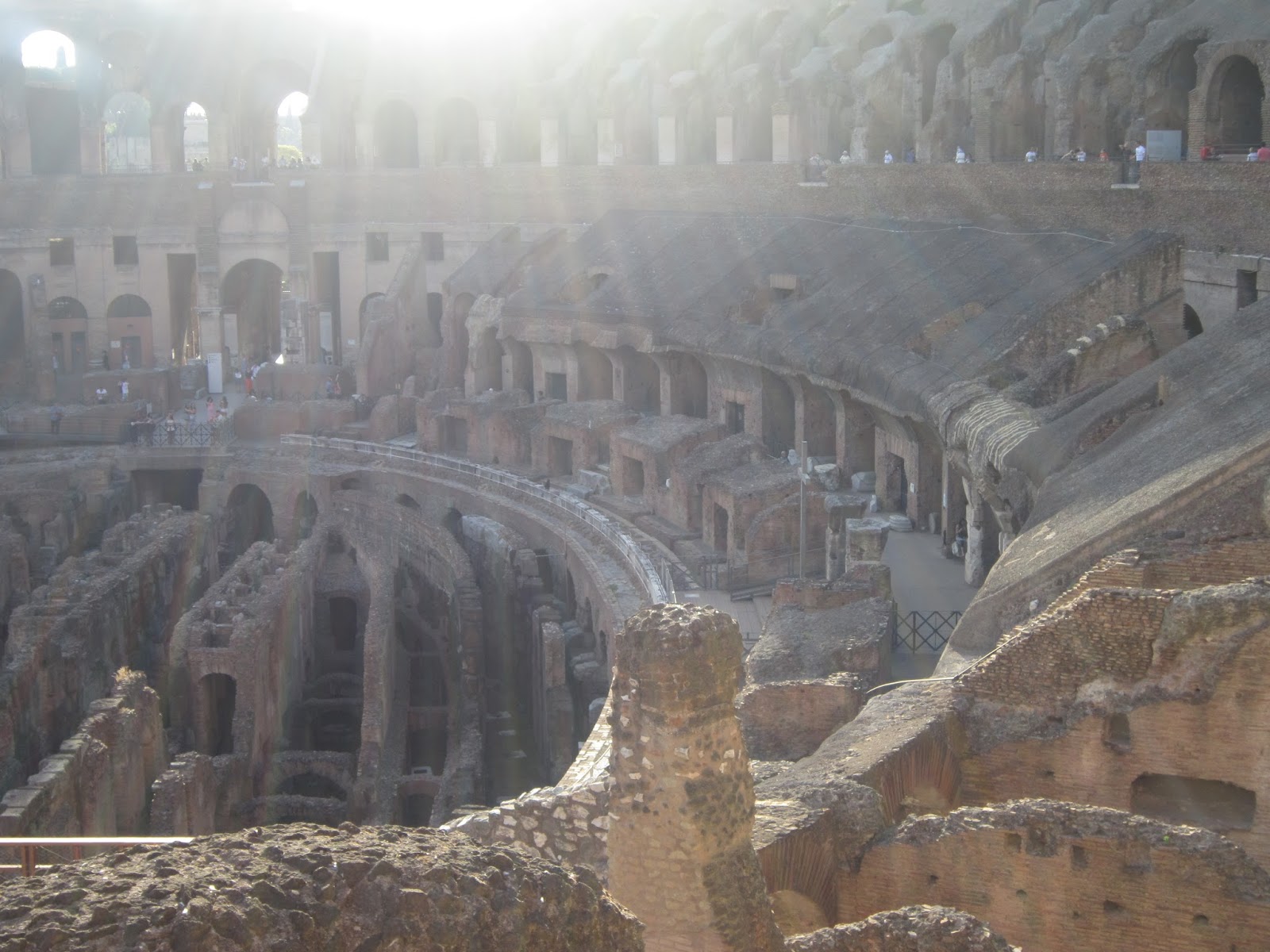 |
| The Colosseum just before sunset. |
 |
| Griffin doorknob in a Roman church |
 |
| Modern art on the doors of Santa Maria degli Angeli |

 |
| Writerly sculpture at the Vatican museum |
 |
| "Here there be dragons" in the Vatican's Map Room |