THE LAST FIFTH GRADE OF EMERSON ELEMENTARY

THE LAST FIFTH GRADE OF EMERSON ELEMENTARY
April 12, 2016
Showing posts with label 100 thousand poets for change. Show all posts

Thursday, July 23, 2015

World Poetry: Ireland

Greetings, Poetry Friday friends. We're crossing the Atlantic again this week to visit my good friend, Irish poet Siobhan Mac Mahon.

The lovely and talented
Margaret Gibson Simon
is hosting Poetry Friday today
at Reflections on the Teche.
Siobhan is Irish Performance Poet, Playwright and Poetry Activist living in England. She performs widely in England, Ireland and Europe. Her poems, powerful and often funny, celebrate our sacred connection to the Earth and the return of the Divine Feminine. She pokes fun at rigid, patriarchal religions and structures, giving voice to the outrageous, the silenced and the banished (and that’s just before she has her breakfast!)

I met Siobhan in Salerno, Italy, during the 100 Thousand Poet for Change World Conference last month. Her poems had us howling with laughter, especially the one about Rita, who goes on a quest to find herself and causes quit an internal tsunami.

Siobhan reading a poem
about Adam's first wife, Lilith.

Siobhan has been writing and performing her poetry, collaborating with other artists and creating mayhem/Spoken word projects for over 20 years. She has combined Spoken Word with music, with dance and with film, working with poets and artists from many different backgrounds and cultures.

Siobhan organizes poetry events, including a yearly event for the 100 Thousand Poets for Change Movement and a large gathering of poets for International Women’s Day. She Co-founded Wicked Words  - a long running Spoken Word evening in Leeds and is currently co-hosting a monthly poetry night in Leeds – Transforming With Poetry.

Siobhan’s poetry has been published  both online and in print including: Margutte,  Tadeeb, Leeds Guide, Print Radio and in a Bloodaxe/ Raving beauties Anthology – Hallelujah for 50 Foot Women.

Her workshops focus on writing poetry as a tool for self- expression, healing and creative growth, often working with marginalized, vulnerable or dis-advantaged groups, including:  homeless people, Those suffering with mental health, bereaved families, Immigrants, carers, long term unemployed, youth groups,  young mothers, stroke survivors, survivors of domestic abuse.


She has also worked in schools and with young people teaching creative writing and performance poetry.

Of the poem she is sharing with us today, Siobhan says, "The Poet is suitable for all ages and talks about the Poet's connection to a deeper reality/the other worlds and especially our connection to the earth as living, sacred and alive. It can be useful for encouraging pupils to get in touch with their  sense of a ‘magical reality’ and to write from that place as poets themselves. In Ireland the poet, in the past, was considered someone who could travel between the worlds."

THE  POET
by Siobhan Mac Mahon 

People often ask me what I do.
Well, I say, last week
 I decorated the downstairs loo’

‘No, no, they say
What is it that you really do?

‘Well, I say
I make a dam fine stew,
lamb and onions, carrots too’.

‘No, no, they say
what is it that you do all day?

‘Well, I say
I’ve been known to pray
and every day I take a walk
and I love to talk’

‘No, no, they say
what is it that you do for money?

‘Oh right, says I
I’ve got you now.
Well, sometimes I make a little honey.

‘Oh right, says they
(Pleased at last)
where is it that you keep the bees?

‘Oh no, says I, I don’t keep bees
I gather nectar from the wild,
distill it all in little jars
and call them verses
one two and three.

I sit upon the quiet shore,
stroke the sun warmed rocks
and sometimes they whisper songs to me,
hidden mysteries of the dark blue sea.

I watch the world unfold
I hear the lonely crying
of the lost souls
come keening down the winds.

I listen to the stories told
by the gurgling of the brazen stream
flowing wildly down the hill
in a rhapsody of ecstasy.

I glimpse
a holy rosary
of blue bells
ringing in the woods.

And I try to remember
all of this to thee,
In verses, one, two and three.

But mostly it’s
nothing much that I do.

Though as I say
I make a dam fine stew.
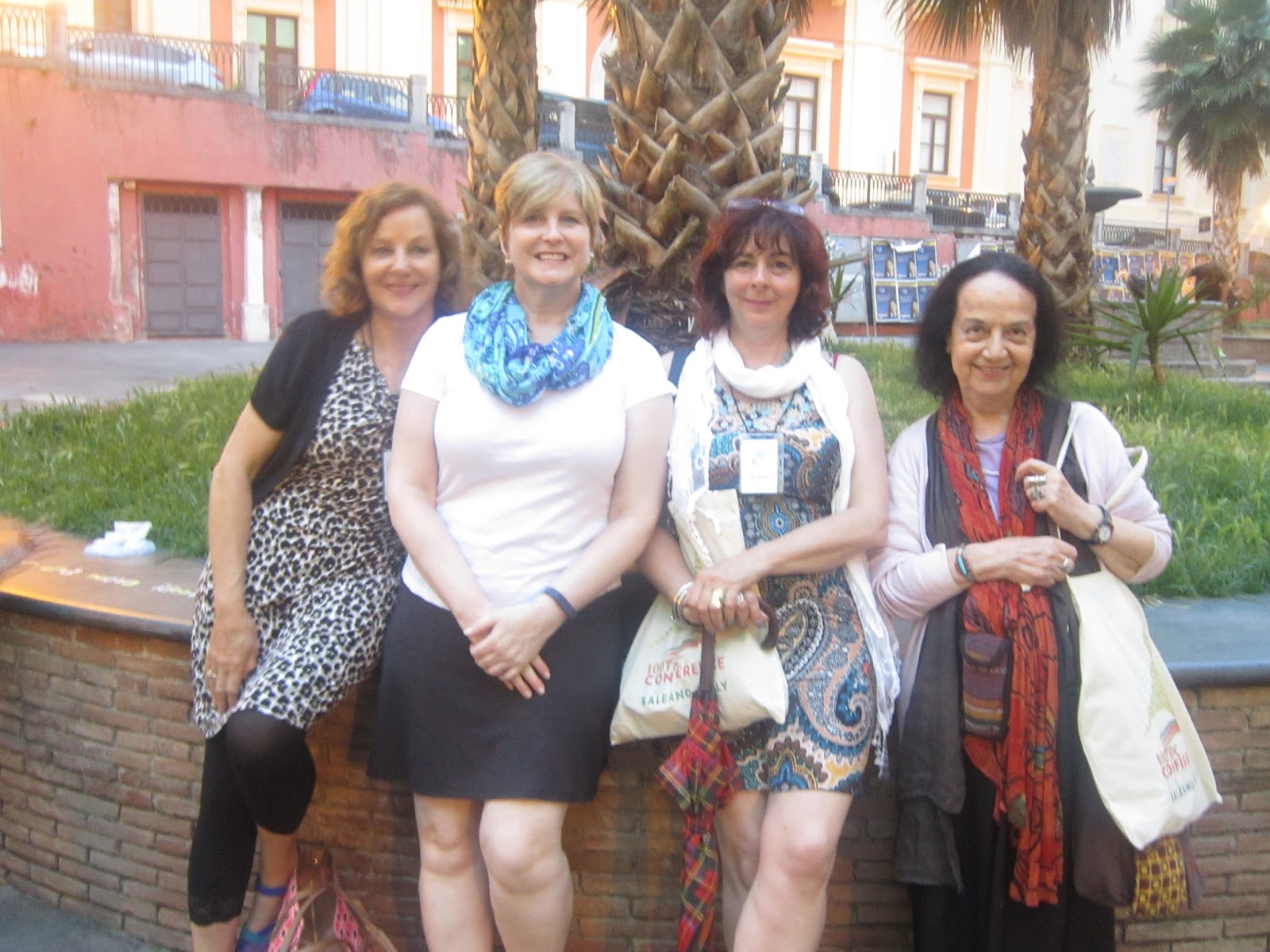

Literary girl power.
(L to R) Ann Bracken, Debby Kevin,
Siobhan Mac Mahon, Carla Bertola.
This poem makes a nice companion to Mary Oliver's poem "The Summer Day." If you work with high schoolers, pairing the two might prompt a good discussion about how two different poets address a similar theme.

Before she leaves us, I asked Siobhan to recommend an Irish poet whose work we might not be familiar with in the U.S. Her choices are:

Performance poet Maighread Medbh and quiet "radical" Rita Ann Higgins. Click on their names to check out each poet's website.

In the World Poetry Series:

World Poetry: India, featuring Menka Shivdasani

World Poetry:Poland, featuring Danuta Kosk-Kosicka and Lidia Kosk

World Poetry: Israel, featuring Michael Dickel

Thursday, July 2, 2015

World Poetry: India

Happy Poetry Friday!


Thanks for hosting this week's poetry links,
Donna Smith. See you at Mainely Write!
It has taken me a few weeks to recover from process my trip to Italy last month. One month ago today, my two travelling companions and I were arriving in Salerno. We quickly settled into our B and B and set off through the narrow, cobbled streets of the city, to find the other poets.


Salerno's waterfront
Debby Kevin, me, and Ann Bracken
were at the conference
to represent Little Patuxent Review.

Ann, Debby, and I had come to Salerno for the first 100 Thousand Poets for Change World Conference. I've blogged about 100 TPC before, but this was my first time meeting other organizers. There were 80 of us from 21 countries!

When people ask about the trip, I can honestly say that the food was AMAZING, especially in Salerno. Since we were in old city Salerno, which is a port town just south of Amalfi, you can imagine that the sights were incredible. But the most important thing that I carried home with me is the friendships we made with other poets.

For the next few weeks, I am going to feature poets who live and work outside the U.S. or are immigrants to this country. Many of these poets are people I met in Salerno, but a few will be local authors who were born in other countries.

To kick off my World Poetry series, I'd like to welcome poet and journalist Menka Shivdasani, of Mumbai, India. At our first formal poetry reading in Salerno, Menka read an amazing feminist piece, "Hinge." 


Menka Shivdasani's third book of poems is
Safe House: A Poetrywala publication.
She is also the editor of If the Roof Leaks, Let it Leak:
A SPARROW publication (fourth in a series
of five volumes featuring Indian women
writers from 23 languages).
The two of us also had time during the conference to chat about our work in the schools and writing poetry with children. That's what we're going to focus on today.

Welcome, Menka!


Note from Menka Shivdasani
Coordinator, Mumbai, 100 Thousand Poets for Change

The 100 Thousand Poets for Change festival in Mumbai, which takes place over four days at the Kitab Khana bookstore, includes one programme for children every year, which is put together by Mrs. Rati Dady Wadia, former principal of Queen Mary School, and a teacher with more than 50 years' experience. She works with children across Mumbai schools to conduct poetry competitions based on themes of peace and sustainability, in tune with the themes of 100TPC. 

The children then present their poems publicly as part of the programme, in a session that includes music and theatre performances as well. Organisations such as The Writers' Bug have also expressed an interest in participating and some of their children had also shared their poems in 2014. [Check out The Writers' Bug website -- it's adorable!]

Last year, we asked children to write about India as well as about other countries for a session titled 'We are the World'. The titles are chosen in a way that children can relate to immediately, and they did, in fact, sing the popular song as well during the session.

While putting together this concept, I wanted children to start thinking about themselves as people who were proud to be Indian, but who also considered themselves as citizens of the world. The idea -- tenuous though it might seem to some -- was that if children started thinking of themselves as world citizens, they would be more amenable to the idea of peace between countries. 


The 2013 100TPC Music of the Spheres event,
photos courtesy of Menka Shivdasani.

This picture shows an enactment
of Gieve Patel's poem On Killing a Tree.
Watch a video about the poem here.
The first step towards this, in my view, was for them to become familiar with other countries and cultures. The children were free to write about whichever country they wished to, and many of them did some research before writing the poems, adding to their knowledge of other global regions. Some children even came to the presentation wearing costumes that represented the countries they were writing about.

When Mrs Wadia introduced the subject, this is what she said:
"India, the land of many religions and cultures – the land that nurtures so many diverse points of view and welcomes people from all walks of life; we are proud to be Indian but also believe that we are one with the world. Ours is a land that has been known for its tolerance over the centuries, and it is that makes India so special. We must all contribute towards keeping this ethos alive and not allow ulterior motives and political gain to overpower this amazing trait.

In a world that is increasingly getting divisive, we can learn to build bridges and break down walls."

She then brought in the concept of peace between countries, and of how it was important, even as we took pride in being Indian, to ensure that we lived in harmony with the rest of the world.

In the previous year, we had asked the children to write about nature and the environment, and these poems are represented in the book as well. The skit by Katie Bagli, 'The Earth Summit', which was performed by the children last year, brought in this theme too.

Menka and Mrs. Rati Dady Wadia
at Kitab Khana bookstore,
which hosted Mumbai's 100TPC poetry event.
Thank you, Menka, and Mrs. Wadia, for telling us about your poetry celebration. I'm pleased to be able to share a student poem from the book THE MUSIC OF THE SPHERES. Prachi Jain's poem "Rome" had special appeal for me because last month was my first visit to Italy. The poem made me think about the way certain places, especially historic ones, exist as a landscape in our minds -- even if we have not visited them.

ROME
by Prachi Jain
Activity High School, Class 9

What have you achieved if you have wandered earth's band
But never attempted to venture Rome's heavenly land?
The city with vast treasures of history
Which on Earth, indeed remains a mystery.

Nursed by a wolf -- two abandoned twins
Who great and fought to see who wins
Romulous stood over Remus, with pride and valour
And ruled over the land, showing off his glamour.

The picturesque city of Venice,
Where fires are breathed into every furnace
Where water flows from how to home
And gondolas row to every dome.

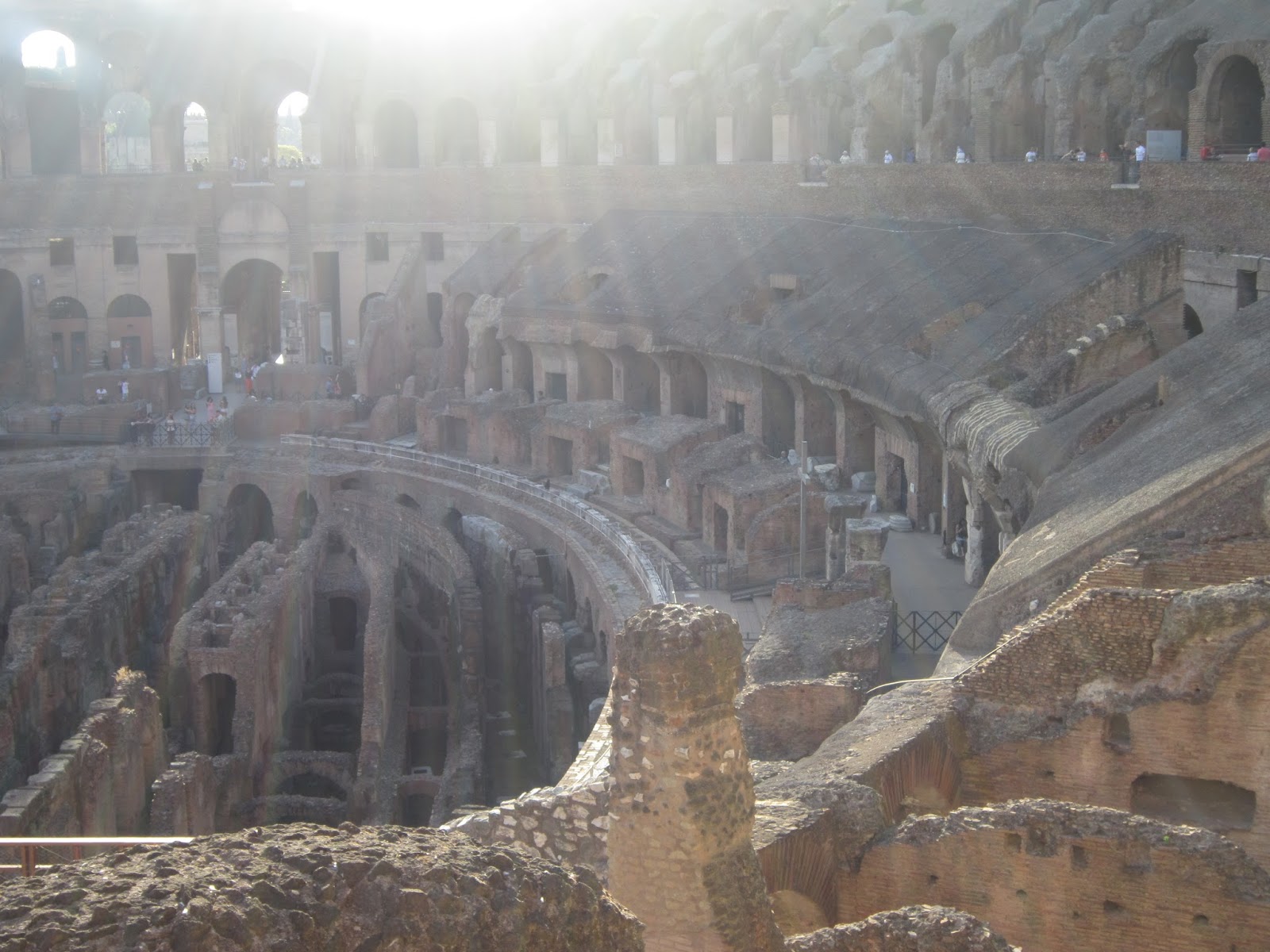
The Colosseum of Rome, known for its gladiator fights
Which today, is known as the land of lights.
It has an enormous underground circular base
The ruins of which still adorn the place.

So that's all I have got to say about Rome.
After all, I can only dream of it from home.
All I can do is persuade you to visit this scenic land
And while going, take me along, hand in hand.

Anthology of student poems written for 100 TPC


Thanks for visiting, Poetry Friday friends. If you have any questions or feedback for Menka, please leave them in the comments.

Enjoy this photo gallery from Rome. I hope Prachi has a chance to visit this city of wonders some day.

The Colosseum just before sunset.
Griffin doorknob in a Roman church

Modern art on the doors of
Santa Maria degli Angeli


Writerly sculpture at the Vatican museum

"Here there be dragons"
in the Vatican's Map Room

Friday, September 28, 2012

Poetry Friday: Lucille Clifton, Children's Author

Tomorrow is 100,000 Poets for Change day, all across the world! Check out the international poster gallery here.

In Baltimore, the date just happens to coincide -- lucky for us -- with the annual Baltimore Book Festival. What better way to honor Poets for Change than with a tribute to Lucille Clifton, who died in 2010.  Her work is a powerful voice for women, for children, for people of color, and for the urban experience. Thanks to CityLit Project, Little Patuxent Review and my co-host, poet Virginia Crawford, for making this tribute discussion and reading possible.

Our event poster, designed by LPR design editor Deb Dulin.
A few weeks ago, I posted about Clifton's new Collected Poems, 1965-2010. I predict it will be an award-winner.

Although she is known as a major American poet, Clifton also authored over a dozen books for children. Her daughter, Alexia Clifton, will be participating in tomorrow's tribute. I asked Alexia about her mother's books for kids.


Hi Laura! 

Hi, Alexia!
 
1. Your mother was a prolific children’s author, yet she is better known for her poetry than for her children’s books. Why do you think that is? Which is your favorite of your mother’s books for children and why?
 
I think that with poetry, Mommy was able to tap into our need for shared human experiences, or "human-ness" as she would say, in a way that other forms of writing simply can't.  I also believe that as I aged, I paid more attention to her poetry than I did the children's books.  As children, my siblings and I were very aware of the books for children and of Mom coming up to schools or doing readings at various libraries.  My favorite is "Some of The Days of Everett Anderson" because it was the first one I remember reading on my own and I just loved the way it flowed. 
Find it on Amazon.
2. The Boy Who Didn’t Believe in Spring was a favorite at our house when our kids were young. I especially appreciate the portrayal of a boy who has a chip on his shoulder, but who is also very much a young boy. I love the book’s surprise ending, how King Shabazz finds spring. Why was it important to your mother to write about urban kids like King Shabazz?

It was always important to Mommy that her children see their reflections in books. She wanted people in urban cities to be able to point to books and tell their children, "see, he's/she's like you!".  We spent a lot of time reading or at libraries as children and always had references that we could identify with.
This book has a great surprise ending.
3. I’m looking at the dialogue, where King says to his friend Tony Polito, “’Everybody talkin bout Spring comin, and Spring just round the corner. I’m going to go round there and see what do I see.’” I noticed that “talkin,” “bout” and “comin” would typically have an apostrophe to show the dropped letter.

As a poet, I see the choice not to add punctuation here as a political statement. This is how King Shabazz speaks. He’s not shortening the word “about” intentionally, to sound cool or street. This is how the word “about” sounds in his neighborhood, among his friends. There’s real dignity and respect for the child as a full person in that small choice. Can you talk about that?

Thanks, she would appreciate your comments about that. One of the things that Mommy always talked about was being realistic. She said that children, in particular, can spot something that is inauthentic and that she wouldn't dishonor them in that way.  She had six children and so was constantly surrounded by conversations and insights from and about kids.  She was also wise enough to know that all children don't speak that way and to respect that as well.  Very often she said, "my commitment is to the story or the poem, not to the storyteller."  She was one heck of a role model.
 
4. From what experiences did your mother draw her characters, such as King Shabazz and Everett Anderson? I imagine that these characters, especially Everett Anderson who stars in a more than a half dozen picture books, became like real people.
This book covers one year of Everett Anderson's life, a poem for each month.
I can remember Mommy saying that when the first Everett Anderson book was published, my brother (her youngest son) was 6 like Everett.  I'm sure that was significant for her though the character isn't based on either of my brothers.

She was always a great observer of life and of people and I think that the characters she wrote about are combinations of lots of types that she was familiar with.  In fact, as kids, we would find ourselves looking at other people and saying, "he reminds me of Everett Anderson" or if their were very relatable characters in children's books, asking, "did Mommy write this?" Pretty funny.
 
5. In her poetry and her books for kids, your mother was a master at the small, but telling detail. I’m thinking of the poem “November” from Everett Anderson’s Year, which is a Thanksgiving prayer. It includes the lines, “thank you for Mama and turkey and fun,/ thank you for Daddy wherever he is.” How would you describe your mother’s ability to say so much in a so few words?

We are as awed by Mommy's ability to do that as everyone else!  I do not remember a time when she couldn't. I've been told that I have a little bit of that gift as well but don't bet on it :-)  

Mommy was a very complex person in a lot of ways and I think that there was a lot of thought that went into her perceived simplicity.  She was a combination of so many things and witness to so many pivotal periods of history and I believe that must have informed who she was.  Authentic and genuine connection was very important to her; and as it turns out, important to us all.

Thanks for stopping by, Alexia. I look forward to tomorrow's event and we're all thrilled that you can participate.
Alexia Clifton
Alexia “Lexi” Clifton is the owner of No Sweat Fitness, Inc. a personal training and fitness studio located in Baltimore. With over twenty years of experience and four national certifications, she enjoys volunteering with First Lady Michelle Obama’s “Let's Move” initiative and “Marathon Kids,” organizations that are dedicated to fighting childhood obesity.

She is her parents’ fourth daughter and youngest child, and has inherited her mother love of reading and her father’s love of physical fitness. She enjoys spending time with her friends and family and is humbled and proud to be a part of her mother's extraordinary legacy. Alexia currently resides in Columbia, Maryland.

Enjoy your Poetry Friday, everyone. For more poetry and more multicultural books, head over to Paper Tigers, our host this week.

Monday, April 23, 2012

30 Habits of Highly Effective Poets #23: Kathy Figueroa on Chores

Kathy Figueroa is one of the many wonderful poets I've met through the 100,000 Poets for Change initiative. She lives in Ontario, Canada.

Kathy has a series of poems about chores. What a great way to turn housework into a source of joy -- by writing about it. It's a new angle on whistle while you work. (For another poet on this subject, check out Julia Alvarez.)

I have been working on simple odes with some fifth graders this week. They love the idea that a few juicy similes and hyperbole can make something as ordinary as masking tape sound amazing! (I even made on-the-spot masking tape art to prove the point.) It's the power of tone. Of course, we talked about Pablo Neruda's Odes to Common Things -- a category which Kathy's poem falls into.

Here is Kathy:

I wrote, 'Ode To Housework,' in practically no time at all because I felt tremendously inspired to sit down and write instead of getting directly to work tidying up the house. (I will say that my yard looks very nice, though.)

Ode To Housework
~by Kathy Figueroa

It's time to clean
This house
Though I'm allergic
To dust
Someone will
Be over soon
So tidying
Is a must
Let me think
Of this drudgery
As something
That's actually fun
Otherwise, it's going
To be awhile
Before I get this
Housework done
Let me delight in
Washing the floor
Instead of thinking
It's such a chore
The cat boxes
Will be fun to change
I'll whistle a tune
As I rearrange
The laundry will go
In the washing machine
The plants
Will be watered
So they stay green
Scrubbing the sink
Won't take as
Long as I think
And then, after I do
I'll polish the loo
Cobwebs can be swept
Away with a broom
Then I'll vacuum
The living room
(Note to myself:
Remember to take care
And make sure I get
All the dog and cat hair)
Yes, I guess
My house is a mess
I could do more
And procrastinate less
Then, in no time
This house
Would be clean
And I'd be
The happiest
Person you've seen

('Ode To Housework,' was first published in The Bancroft Times newspaper on January 5, 2012.)


The Bancroft Times included this illustration "originally made from engravings created, in large part, by renowned artisans, Thomas and John Bewick, date from prior to 1784!"

You can read more of Kathy's work -- including several more from her "housework" series, at her Facebook page.


You can also find clips of Kathy reading her work on YouTube.

Monday, April 9, 2012

30 Habits of Highly Effective Poets #9: Lisa Vihos on Practicing

I "met" poet Lisa Vihos through 100 Thousand Poets for Change, a global poetry initiative begun by Michael Rothenberg. You can read my interview with Michael here.
A 2011 100 TPC poster.
Lisa was enthusiastic about sharing her story -- how a long period of regular writing practice eventually paid off for her -- because it's so encouraging. If you believe in Malcolm Gladwell's theory that it takes 10,000 hours of practice before one achieves mastery in a skill or art form, Lisa's writing habit makes sense.
The 10,000 hours theory appears in Gladwell's book Outliers.

I "tested" the 10,000 hour theory on my own writing life. Although I don't have an official log of hours spent writing, I guess-timated how much time I spent writing each year, from the time I finished graduate school to the time my first book came out. It's right around Gladwell's mark.

Here is Lisa: Prepare and Set Aside

For many years, I danced around my poetry, trying various literary avenues: children’s book writing, art writing, short story writing, journaling. Nothing blossomed and whenever I met a published writer, I broke out in an envious sweat. I was troubled.

Then, something like a small miracle occurred. After participation in a workshop with poet Philip Dacey at the 2007 Great Lakes Writers Festival at Lakeland College, I felt as though a faucet had opened up in my head. Poems started to pour out. I knew I needed a goal to sustain the flow. In January 2008, I determined to write a poem every week and email it to a small circle of family and friends. I did not expect commentary, just eyes and minds to engage in the work. One friend asked, “do you really think you can write a new poem every week?” I had no idea. But, I had to try.

Eventually, my distribution list grew to over 200 people. I never missed a deadline in three years and three months of Sundays. Not every poem was stellar, but most of the poems were pretty good, and certain people always let me know when something touched, tickled, or confused them. One of my readers is a widely published poet who eventually suggested that I cut back my frequency in order to better hone my craft. I liked this idea, and in March 2011, I started to send a poem only on the first of the month. I think about potential poems all month long, but I often don’t start writing until just before my deadline. I’ve always worked best under pressure.

In her April 1st blog post, Laura shared a recipe for an inspiring green tea shake that involved organic pecans being prepared the night before and then set aside. Likewise, a poem (or even a whole lifetime of poetry?) benefits from being left to marinate. But don’t put it on hold forever. Return with fresh eyes as soon as you can and write more. If I learned anything in my three-year apprenticeship, it was to develop a practice of mind and to think as a poet. To collect details, connections, snippets; to steep them, savor them, and eventually turn them into poems.

My favorite Poem of the Week comment came from a neighbor who said, “Thank you for your dedication. You have inspired me to revisit my songwriting.” A comment like that makes my heart sing. That is what poetry is for, in my opinion: to move and inspire, to point out that which would otherwise go unnoticed. On that note, I’d like to share the poem with which Poem of the Week began on a winter day in 2008.

Advice from the Snow
by Lisa Vihos

When you fall, fall as I do
soft as feathers or a baby’s sleep.

With a light hand, spread an ocean of diamonds.
Make no sound as you blanket the earth.

Reflect light back upon the looker
orange and pink at morning, deep mauve at dusk.

Simply by your presence, round out flat places
and outline beauty that otherwise goes unnoticed.

And when I call you, do not be afraid to lie down
to bring forth an angel; an image of you in me.

How successful has Lisa been since her three year weekly-poem project? "Advice from the Snow" was published in the 2011 Wisconsin Fellowship of Poets poetry calendar. Lisa’s poems have also appeared in Big Muddy, Goose River Anthology, Lakefire, Red Cedar, Seems, Verse Wisconsin, and Wisconsin People and Ideas. She has one Pushcart Prize nomination and one chapbook, A Brief History of Mail (Pebblebrook Press, 2011). Her second chapbook, The Accidental Present is due from Finishing Line Press in June of this year.

Tomorrow is Tuesday. Stop by each Tuesday during National Poetry Month for a prompt related to writing habits.

Sunday, September 25, 2011

Living Poems at 2011 Baltimore Book Festival

Yesterday was our big 100 Thousand Poets for Change event.

Gregg Wilhelm of CityLit Project was awesomeness itself, hosting our Living Poetry Flash Mob at the CityLit Stage.

Me, Gregg Wilhelm of CityLit Project, and my co-conspirator, poet Virginia Crawford.

Ginny and I designed this family literacy activity for the 100 Thousand Poets for Change event happening worldwide on Saturday, 9/24/11. You can visit the 100 TPC website to watch video and see photos of events in Afghanistan, Egypt, Australia, Washington, DC, etc.

I tried to convince Baltimore's Best Hon to be in a living poem. She had too many adjectives to fit in one line of verse.

Here are my favorite Living Poems from Saturday.


Courage waving toward time

Face the path beyond fear

I become fire and kiss everyone out of time

May you inspire poetry

The path beyond fear feels change become courage

And my favorite poem, because it captures the 100 TPC spirit:
Everyone human become a revolutionary innocence
We donated the "gently used" tee-shirts to a local charter school, where a fifth grade teacher wants to try Living Poetry in her classroom. I'm happy to report 100 TPC founder Michael Rothenberg got a big kick out of the Living Poem photos.

Tomorrow, I'll post about the "Poets for Social Justice Panel," sponsored by Little Patuxent Review. What a valuable discussion about Social Justice issues in the U.S! LPR will have video of the conversation available online later this week.

Reminder -- LPR is accepting submissions for our Social Justice issue through November 1.

UPDATE: One of the surprises about this project -- revision! One poet would begin a poem, but others in the crowd would switch out or add a word. Fascinating to see revision in living process, not on the page, but with people.