THE LAST FIFTH GRADE OF EMERSON ELEMENTARY

THE LAST FIFTH GRADE OF EMERSON ELEMENTARY
April 12, 2016
Showing posts with label world poetry series. Show all posts

Thursday, August 20, 2015

World Poetry: India

It's Poetry Friday. Take another spin around the globe with  me. Today, we are visiting an accomplished young poet from India, Supriya Kaur Dhaliwal.


Supriya Kaur Dhaliwal (born June 27, 1995) is an Indian poet and writer. She is author of two books of poems, The Myriad (2011) and Musings of Miss Yellow (2015).

The only daughter of Simerjit Kaur Dhaliwal and Yadwinder Singh Dhaliwal, Supriya was was born and brought up in the vicinity of lush green tea gardens and majestic Himalayan valley, Palampur. The town is located in Himachal Pradesh, India where her Sikh parents sought refuge from the rapid pace of the rest of the country and sought solace in the lap of nature. At the age of seven she wrote her first poem, and she first saw publication in a widely read newspaper, The Tribune when she was fifteen years old.

Supriya is currently living in Shimla, where she's studying English Literature at St. Bede's College. She authored her first book of poems at the age of sixteen. Her debut anthology received immense love from its readers which triggered the poetry bug in her to a newer level. 


She is actively involved in the literary scene in India, contributing to numerous literary carnivals across the country, including Kumaon Literary Festival and Delhi Poetry Festival . She is also the core team member of Poets Corner, a one of a kind poetry collective based in the historic city of New Delhi. She aims at reviving this literary spirit in the youth of India which she believes is dwindling at a panther pace.

Her poems are widely anthologized across the globe, Earl of Plaid (USA), A Poet's View of Being (Canada), The Taj Mahal Review (India), Acerbic Anthology (Nigeria).  Her sophomore poetry anthology, Musings of Miss Yellow was recently published. It started its journey from the 100 Thousand Poets for Change World Conference in Salerno, Italy. 


Find the book here.

Musings of Miss Yellow is divided into six sections: A Tryst with Tales in Rhyme, Arcadia, Gobbledygook, If, Rumination and Saudade respectively.

Sharing her experience from the recent 100 TPC World Conference in Italy, Supriya says:

"People often mock and giggle when I tell them I am a poet. They end up patting my back over a ruthless comment, 'You’re just a young woman deciding who she will be.' Last month, I took a leap of faith and traveled to Salerno, Italy to attend the 100 Thousand Poets for Change World Conference. I met poets from so many countries that I failed to maintain a count. 


"When I boarded my last plane from Dubai with a heavy heart, I felt as if I had seen the entire world in one shot. The organizers of the conference, Alfonso Gatto Fondazione and 100 Thousand Poets for Change, translated a few poems from this sophomore poetry collection into Italian and posted a stanza of my poem “If I have a Daughter” with my picture on their Facebook page. 

"One fine evening, when almost everyone was high on poetry and alcohol, nearly about to explode with euphoria while dancing on the tunes of Campagnia Daltrocanto, a local traditional Neopolitan band, a man who spoke only Italian and no English walked by my side to examine my face. He then took out his phone, opened up that particular picture of me on conference’s Facebook page, posted with a stanza of my poem 'If I have a Daughter' in Italian and moved his fingers to confirm if it was me. I smiled and nodded. He said something then, which I failed to understand, still I smiled and nodded and resumed dancing on those energetic beats. After a few minutes, he came to me again. This time he had the Google Translator opened on his phone window. He handed me his phone. He had got the Italian word 'mosso' translated for me into English. 'Mosso' is synonymous to 'moved'. He wanted to tell me he was moved by my poem. My eyes felt heavy. I bowed and said 'grazie' (thank you). I guess I’ll master the Italian language one day and translate Musings of Miss Yellow into Italian myself. I’ll then go to Salerno again to gift him the first copy of 'Riflessioni di Perdere Giallo.'
Supriya in Salerno.
"Being a young poet in India is almost like waking up to a challenge every day. Well, to me, poetry is something that I’d envisaged for my future since the day when I was not even a teenager. I had always wanted by bind my illicit and unripened verses into a slice of surreal treatise. 

"It may sound strange, but there were actually two things that inspired me to write this book. Firstly, it was the sarcastic tone of the society. Though it wasn’t threatening or scathing, but I’d always wanted to upshot the basic convictions of the world around us. Secondly, the nature around me has always fascinated and inspired me beyond any possible levels of anticipation. We were, rather are, always taught at the school that these trees and flowers are categorized as living creatures and they differ us only by the means of communication. So since my early teenage, I have always tried to place myself at their place and speak up a language that perfectly fits in this universal natural maze."

Recommended poet:

"There's this one poet who has always stayed with me, her name is Amrita Pritam, a very prominent female poet in the Indian literary scene who wrote in my mother tongue Punjabi. 
Ajj aakhaan Waris Shah nu (Today I invoke Waris Shah – "Ode to Waris Shah"), an elegy written by her to the 18th-century Punjabi poet, an expression of her anguish over massacres during the partition of India never fails to touch me in the most poignant manner every time I read it."

 [Note: You'll find the poem in English and Punjabi, with historical background about the massacres, at this blog.]

Although I met Supriya at the 100 Thousand Poets for Change conference, I feel that I have met her again through the biography and statements she shared with us today. She was kind enough to share two poems. The first is recommended for upper elementary and older. The second is appropriate for high school and up.

Power of Hope
by Supriya Kaur Dhaliwal (at age 15)
from The Myriad

When all memories leave you with gloom
And you are left with nothing but doom
When you are crippled and you need a rope
Hold your breathe and give yourself a chance of hope
By ignoring the brain and following the heart
Give your life a new start
Build your way when it is hard to climb
Have no fear, because you haven’t done a crime
Taking small steps, learn to cope
Slowly and slowly build you’ll build your hope
Memory
by Supriya Kaur Dhaliwal
from Saudade, Musings of Miss Yellow

Like an
infinite number of concentric circles,
it stretches its existence
beyond an unfelt level.
And like the rings
that increase in number
every year
under the skin of
a tree’s trunk-
it keeps on adding
time, maybe years
to itself.
Yes, I’m talking 
about your memory.
You are the center 
of my concentric circles.
Your memory, I’m sure
will gaze like an addled sage
till what they call- eternity
on my love’s age.

One day
your indifference 
I’ll assume
to be a stone.
Out of angst, 
I’ll let it moan
on the lake’s water.
The ripples 
will refuse to stay
and I wonder
if your memory
will forever sway.
It's exciting to meet young adults who have a deep love for and commitment to poetry. I applaud Supriya for being so involved in the poetry community. All of the 100 Thousand Poets members are looking forward to watching (and reading) what she does in the future.

Catherine at Reading to the Core
is hosting Poetry Friday this week.
Stop by her blog
for all of this week's links.
In the World Poetry Series:

World Poetry: India, featuring Menka Shivdasani

World Poetry:Poland, featuring Danuta Kosk-Kosicka and Lidia Kosk

World Poetry: Israel, featuring Michael Dickel

World Poetry: Ireland, feature Siobhan Mac Mahon

Thursday, July 23, 2015

World Poetry: Ireland

Greetings, Poetry Friday friends. We're crossing the Atlantic again this week to visit my good friend, Irish poet Siobhan Mac Mahon.

The lovely and talented
Margaret Gibson Simon
is hosting Poetry Friday today
at Reflections on the Teche.
Siobhan is Irish Performance Poet, Playwright and Poetry Activist living in England. She performs widely in England, Ireland and Europe. Her poems, powerful and often funny, celebrate our sacred connection to the Earth and the return of the Divine Feminine. She pokes fun at rigid, patriarchal religions and structures, giving voice to the outrageous, the silenced and the banished (and that’s just before she has her breakfast!)

I met Siobhan in Salerno, Italy, during the 100 Thousand Poet for Change World Conference last month. Her poems had us howling with laughter, especially the one about Rita, who goes on a quest to find herself and causes quit an internal tsunami.

Siobhan reading a poem
about Adam's first wife, Lilith.

Siobhan has been writing and performing her poetry, collaborating with other artists and creating mayhem/Spoken word projects for over 20 years. She has combined Spoken Word with music, with dance and with film, working with poets and artists from many different backgrounds and cultures.

Siobhan organizes poetry events, including a yearly event for the 100 Thousand Poets for Change Movement and a large gathering of poets for International Women’s Day. She Co-founded Wicked Words  - a long running Spoken Word evening in Leeds and is currently co-hosting a monthly poetry night in Leeds – Transforming With Poetry.

Siobhan’s poetry has been published  both online and in print including: Margutte,  Tadeeb, Leeds Guide, Print Radio and in a Bloodaxe/ Raving beauties Anthology – Hallelujah for 50 Foot Women.

Her workshops focus on writing poetry as a tool for self- expression, healing and creative growth, often working with marginalized, vulnerable or dis-advantaged groups, including:  homeless people, Those suffering with mental health, bereaved families, Immigrants, carers, long term unemployed, youth groups,  young mothers, stroke survivors, survivors of domestic abuse.


She has also worked in schools and with young people teaching creative writing and performance poetry.

Of the poem she is sharing with us today, Siobhan says, "The Poet is suitable for all ages and talks about the Poet's connection to a deeper reality/the other worlds and especially our connection to the earth as living, sacred and alive. It can be useful for encouraging pupils to get in touch with their  sense of a ‘magical reality’ and to write from that place as poets themselves. In Ireland the poet, in the past, was considered someone who could travel between the worlds."

THE  POET
by Siobhan Mac Mahon 

People often ask me what I do.
Well, I say, last week
 I decorated the downstairs loo’

‘No, no, they say
What is it that you really do?

‘Well, I say
I make a dam fine stew,
lamb and onions, carrots too’.

‘No, no, they say
what is it that you do all day?

‘Well, I say
I’ve been known to pray
and every day I take a walk
and I love to talk’

‘No, no, they say
what is it that you do for money?

‘Oh right, says I
I’ve got you now.
Well, sometimes I make a little honey.

‘Oh right, says they
(Pleased at last)
where is it that you keep the bees?

‘Oh no, says I, I don’t keep bees
I gather nectar from the wild,
distill it all in little jars
and call them verses
one two and three.

I sit upon the quiet shore,
stroke the sun warmed rocks
and sometimes they whisper songs to me,
hidden mysteries of the dark blue sea.

I watch the world unfold
I hear the lonely crying
of the lost souls
come keening down the winds.

I listen to the stories told
by the gurgling of the brazen stream
flowing wildly down the hill
in a rhapsody of ecstasy.

I glimpse
a holy rosary
of blue bells
ringing in the woods.

And I try to remember
all of this to thee,
In verses, one, two and three.

But mostly it’s
nothing much that I do.

Though as I say
I make a dam fine stew.


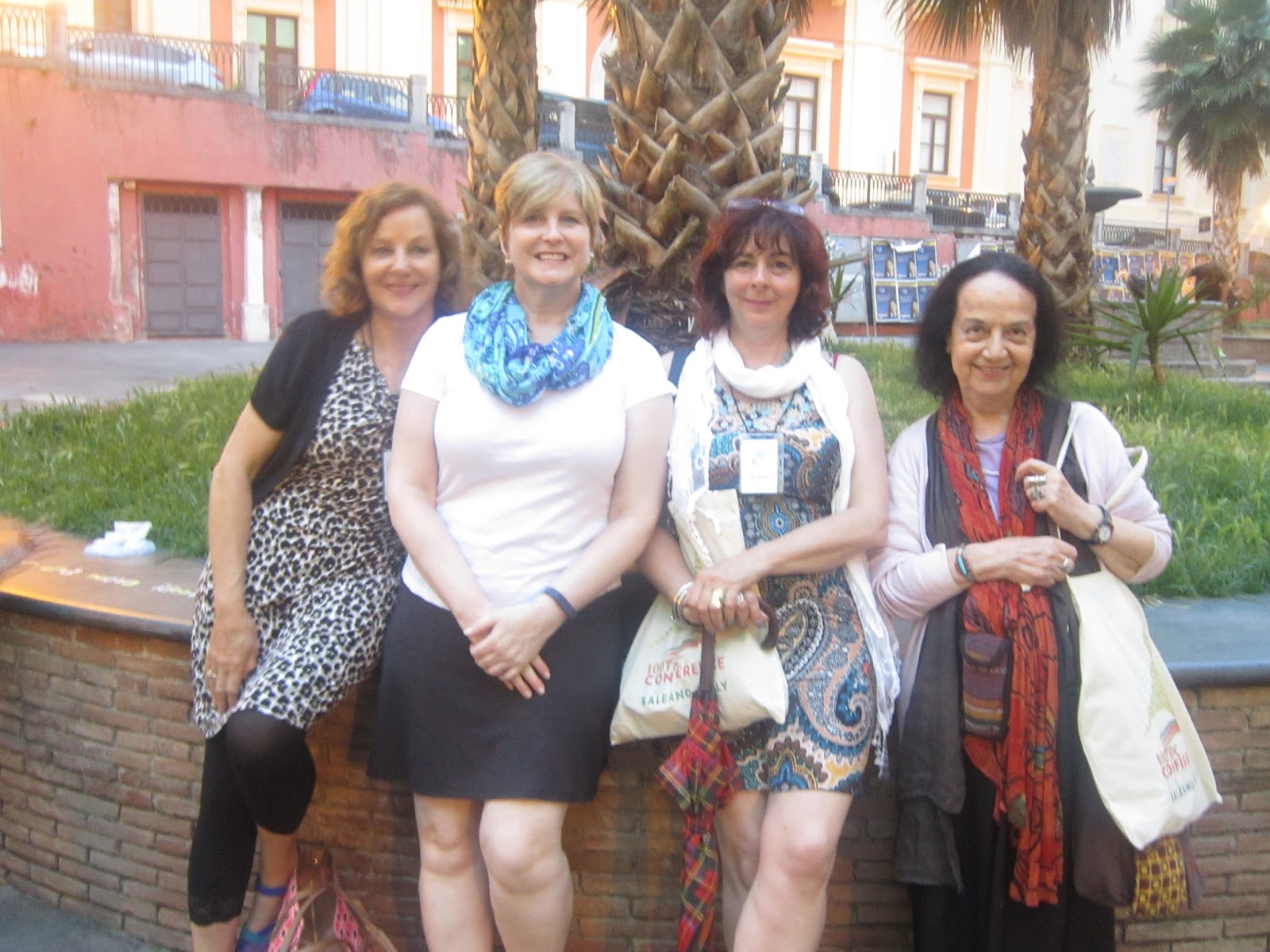
Literary girl power.
(L to R) Ann Bracken, Debby Kevin,
Siobhan Mac Mahon, Carla Bertola.
This poem makes a nice companion to Mary Oliver's poem "The Summer Day." If you work with high schoolers, pairing the two might prompt a good discussion about how two different poets address a similar theme.

Before she leaves us, I asked Siobhan to recommend an Irish poet whose work we might not be familiar with in the U.S. Her choices are:

Performance poet Maighread Medbh and quiet "radical" Rita Ann Higgins. Click on their names to check out each poet's website.

In the World Poetry Series:

World Poetry: India, featuring Menka Shivdasani

World Poetry:Poland, featuring Danuta Kosk-Kosicka and Lidia Kosk

World Poetry: Israel, featuring Michael Dickel

Thursday, July 16, 2015

World Poetry: Israel

Happy Poetry Friday, poetry lovers!


This week's host is Kimberley Moran.
Stop by her place to find poetry posts
from all of your Poetry Friday pals.
I'm continuing my trip around the world, visiting with poets who originate from or live in countries other than the United States. Many of the poets I am featuring in this series were part of the 100 Thousand Poets for Change World Conference. Last month, we spent a week together in Salerno, Italy, talking about poetry, politics, and about being poetry advocates in our home communities.

This week, I'd like to introduce you to my dear friend, Michael Dickel.


Michael Dickel reading at the 100 TPC World Conference.
Photo by Adelia Parker-Castro
One of the realities of meeting people from around the world is learning about the political conflicts that affect many of their lives. It's one thing to read about these issues in the newspaper. But reading a poem about war, written by someone I know, feels much more real than the news.

This is true of Michael, who was born in the U.S., but has lived for many years in Israel.

Michael Dickel is a Jewish-American dual-citizen of the United States and Israel. He was born and grew up outside of Chicago. He lived in the Twin Cities—except for two years in Connecticut—until moving to Israel eight years ago. In his early adult years, he worked with runaway teens and urban youth, with children at an in-patient psychiatric evaluation unit, and at a crisis intervention and suicide prevention center. 

Michael started writing poetry in grade school. He holds a masters degree in creative writing and a doctorate in English literature. For over 25 years, he has taught in higher education in the U.S. and in Israel—writing and literature, as well as English language and education. He also directed writing centers in the U.S. 

His maternal grandmother taught in a one-room school house; his mother taught elementary school; his father, high school; and many first and second cousins also teach—teaching is probably in his genes.

Michael has done word-play workshops for elementary school children in Minnesota and poetry workshops for high-school students in Minnesota and Israel. Most recently, he conducted poetry workshops related to peace at The Jerusalem School in the Beit Hanina neighborhood of East Jerusalem. The school's motto is "Peace begins with me," and the workshops coincided with its annual Peace Days.

He wrote “Overlook” for the first of these workshops. In the workshops, students were asked to use their senses to describe peace, or how they imagined it. One Palestinian young man wrote this sad, powerful response: “I never smell peace. / I never taste peace, either. / Nothing I hear sounds like peace. / Nothing I touch feels like peace. / Anywhere I go, I never see peace.”

Michael’s third book of poetry, War Surrounds Us, came out this summer. 

Find it on Amazon.

The book contains poems written during the 2014 Israel-Hamas war. Many of the poems, which focus on his family and everyday life during the conflict, are suitable for mature high-school students. 

However, the poem we are featuring today is appropriate for older elementary schoolers and up.

Overlook

Along the Alon Road, near
where we once glimpsed
an Athena owl, the road
widens for cars to rest.
The look-out holds two old
olive trees together, friends.

New maps show new divisions.
Old maps recall old boundaries.
Stone fences, barbed wire
come and go. Land mines
lay sleeping. But the olive
branches don't see these.

Standing guard by the road,
the two see open land: valleys,
wadis, and fields from here
to Jordan's distant mountains
and beyond—slow-moving possibility.

                        —Michael Dickel

Glossary / notes

Alon Road—a winding, two-lane road on the West Bank. It is named for a person but alon also is Hebrew for the live oak tree.

Athena owl—a small, brown owl native to the region

Michael was kind enough
to share this photograph
of the owl (the actual owl)
that inspired the poem.
Wadi—Arabic for gulch or eroded canyon, adopted in Hebrew. Wadi is distinct, here, from valleys because a wadi has steep sides whereas the Jordan River valley is wide with rolling hills, not a canyon. The plural with an “s,” wadis, is an Anglicized usage that also occurs in Israel among English speakers.

Dickel, M. (2013). Overlook. Fragments of Michael Dickel. Blog. 30 April.
http://mydekel.wordpress.com/2013/04/30/overlook-a-peace-poem/


Thanks for visiting today, Michael!

In the World Poetry Series:

World Poetry: India, featuring Menka Shivdasani

World Poetry:Poland, featuring Danuta Kosk-Kosicka and Lidia Kosk

Thursday, July 9, 2015

World Poetry: Poland

Happy Poetry Friday! First, in case you missed my happy screams on Wednesday, it was cover reveal day for THE LAST FIFTH GRADE OF EMERSON ELEMENTARY. Check out these adorable kids.


Don't be spacey, head over to
The Logonauts.
Katie is hosting this week's
Poetry Friday blog-roll.
Now on to Poetry Friday.

Last month, I traveled to Salerno, Italy for a world poetry conference. For the next several Poetry Fridays, I am featuring poets from around the globe. Some of these poets are people I met in Salerno and others are part of the literary community here in central Maryland.

On Monday, I was at a reading to celebrate the launch of two news books by today's poet, Danuta E. Kosk-Kosicka. Her website is here.


Monday night's reading was at LitMore.

Danka came to the U.S.  in 1980 from Poland on a postdoctoral fellowship from the Muscular Dystrophy Association. She writes in English, but also translates from Polish to English. One of her ongoing projects is translating the work of her mother, the Polish poet Lidia Kosk.

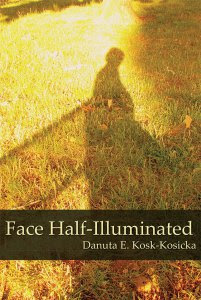
Two books at the same time?! This year has been an abundance of riches in Danka's writing life. First, her book Face Half-Illuminated was accepted by Apprentice House Books, our country's oldest student-run independent press. This is an unusual book, because it combines Danka's own poems and essays with her translations of her mother, the Polish poet Lidia Kosk. (A previous book, Niedosyt/Reshapings, is bilingual, and includes Lidia Kosk's poetry in Polish, side by side with Danka's translations.)


Available from Apprentice House books.
On the heels of that acceptance, Danka found out that a chapbook of her own poems won the 2015 Harriss Poetry Prize and would be published by CityLit Press. The book is titled Oblige the Light.


A list of Harriss Prize winners is here.

Danka reminded me that the two of us met in 2010, when my Harriss Prize chapbook Mountain, Log, Salt, and Stone was published. She and her husband attended the launch reading at CityLit Festival. We have been friends since then. I'm a fan of Danka's work and, as editor, have selected it to appear in one of my anthology's and multiple times in Little Patuxent Review.

Danka didn't start her career as a poet until later in life. She came to the U.S. to work as a biochemist, eventually doing research at Johns Hopkins in Maryland. Her arrival in America occurred just as a period of political upheaval began in Poland. Many of her poems express the history of war in Europe and political oppression in her native country that Danka and her family witnessed.


If you'd like to read more about Danka's fascinating background, you'll find my interview with her here. 


From Niedosyt/Reshapings


Lidia Kosk

Z okna mojego mieszkania

Nad domem naprzeciwko,
co oknami patrzy ku memu oknu,
zawiesił się księżyc,
wśród skał i kamieni z obłoków.
I wisiał długo, wytrwale,
aż zapomniałam, że z nim zerwałam
na stałe.
Aż zapomniałam, że w duszy
już tak dawno brak grania,
aż cała byłam z zapamiętania.


Translated by Danuta E. Kosk-Kosicka

From the Window of My Apartment

Above the apartment house,
whose windows exchange looks with mine,
the moon got stuck
among the rocks and boulders of clouds.
He kept hanging there, stubbornly,
until I forgot that I had broken with him
permanently.
Until I forgot that my soul
did not sing anymore.
Until all of me was a song.


From Oblige the Light

Danuta E. Kosk-Kosicka

My Mother at Twelve
Minkowice, Poland, 1940
Hours of waiting at the bakery,
all my money for a last loaf of bread.
Now, cycling kilometers to hunger at home.

Near the hamlet where roads cross,
I see German soldiers rounding up people,
my friend Hana among them.

I jump off the bicycle, run toward Hana
with the still-warm bread. “Death for helping Jews,”
the soldier points his gun at my chest. I trip and fall;
a bullet wails.

When darkness lifts,
I see trampled bread on the empty road.

Here is Danka reading one of my favorite poems of hers, "The Movie in My Head," at a Little Patuxent Review event. Please visit https://danutakk.wordpress.com/ to read more of Danka's work.


In the World Poetry Series:

World Poetry: India, featuring Menka Shivdasani

Thursday, July 2, 2015

World Poetry: India

Happy Poetry Friday!


Thanks for hosting this week's poetry links,
Donna Smith. See you at Mainely Write!
It has taken me a few weeks to recover from process my trip to Italy last month. One month ago today, my two travelling companions and I were arriving in Salerno. We quickly settled into our B and B and set off through the narrow, cobbled streets of the city, to find the other poets.


Salerno's waterfront
Debby Kevin, me, and Ann Bracken
were at the conference
to represent Little Patuxent Review.

Ann, Debby, and I had come to Salerno for the first 100 Thousand Poets for Change World Conference. I've blogged about 100 TPC before, but this was my first time meeting other organizers. There were 80 of us from 21 countries!

When people ask about the trip, I can honestly say that the food was AMAZING, especially in Salerno. Since we were in old city Salerno, which is a port town just south of Amalfi, you can imagine that the sights were incredible. But the most important thing that I carried home with me is the friendships we made with other poets.

For the next few weeks, I am going to feature poets who live and work outside the U.S. or are immigrants to this country. Many of these poets are people I met in Salerno, but a few will be local authors who were born in other countries.

To kick off my World Poetry series, I'd like to welcome poet and journalist Menka Shivdasani, of Mumbai, India. At our first formal poetry reading in Salerno, Menka read an amazing feminist piece, "Hinge." 


Menka Shivdasani's third book of poems is
Safe House: A Poetrywala publication.
She is also the editor of If the Roof Leaks, Let it Leak:
A SPARROW publication (fourth in a series
of five volumes featuring Indian women
writers from 23 languages).
The two of us also had time during the conference to chat about our work in the schools and writing poetry with children. That's what we're going to focus on today.

Welcome, Menka!


Note from Menka Shivdasani
Coordinator, Mumbai, 100 Thousand Poets for Change

The 100 Thousand Poets for Change festival in Mumbai, which takes place over four days at the Kitab Khana bookstore, includes one programme for children every year, which is put together by Mrs. Rati Dady Wadia, former principal of Queen Mary School, and a teacher with more than 50 years' experience. She works with children across Mumbai schools to conduct poetry competitions based on themes of peace and sustainability, in tune with the themes of 100TPC. 

The children then present their poems publicly as part of the programme, in a session that includes music and theatre performances as well. Organisations such as The Writers' Bug have also expressed an interest in participating and some of their children had also shared their poems in 2014. [Check out The Writers' Bug website -- it's adorable!]

Last year, we asked children to write about India as well as about other countries for a session titled 'We are the World'. The titles are chosen in a way that children can relate to immediately, and they did, in fact, sing the popular song as well during the session.

While putting together this concept, I wanted children to start thinking about themselves as people who were proud to be Indian, but who also considered themselves as citizens of the world. The idea -- tenuous though it might seem to some -- was that if children started thinking of themselves as world citizens, they would be more amenable to the idea of peace between countries. 


The 2013 100TPC Music of the Spheres event,
photos courtesy of Menka Shivdasani.

This picture shows an enactment
of Gieve Patel's poem On Killing a Tree.
Watch a video about the poem here.
The first step towards this, in my view, was for them to become familiar with other countries and cultures. The children were free to write about whichever country they wished to, and many of them did some research before writing the poems, adding to their knowledge of other global regions. Some children even came to the presentation wearing costumes that represented the countries they were writing about.

When Mrs Wadia introduced the subject, this is what she said:
"India, the land of many religions and cultures – the land that nurtures so many diverse points of view and welcomes people from all walks of life; we are proud to be Indian but also believe that we are one with the world. Ours is a land that has been known for its tolerance over the centuries, and it is that makes India so special. We must all contribute towards keeping this ethos alive and not allow ulterior motives and political gain to overpower this amazing trait.

In a world that is increasingly getting divisive, we can learn to build bridges and break down walls."

She then brought in the concept of peace between countries, and of how it was important, even as we took pride in being Indian, to ensure that we lived in harmony with the rest of the world.

In the previous year, we had asked the children to write about nature and the environment, and these poems are represented in the book as well. The skit by Katie Bagli, 'The Earth Summit', which was performed by the children last year, brought in this theme too.

Menka and Mrs. Rati Dady Wadia
at Kitab Khana bookstore,
which hosted Mumbai's 100TPC poetry event.
Thank you, Menka, and Mrs. Wadia, for telling us about your poetry celebration. I'm pleased to be able to share a student poem from the book THE MUSIC OF THE SPHERES. Prachi Jain's poem "Rome" had special appeal for me because last month was my first visit to Italy. The poem made me think about the way certain places, especially historic ones, exist as a landscape in our minds -- even if we have not visited them.

ROME
by Prachi Jain
Activity High School, Class 9

What have you achieved if you have wandered earth's band
But never attempted to venture Rome's heavenly land?
The city with vast treasures of history
Which on Earth, indeed remains a mystery.

Nursed by a wolf -- two abandoned twins
Who great and fought to see who wins
Romulous stood over Remus, with pride and valour
And ruled over the land, showing off his glamour.

The picturesque city of Venice,
Where fires are breathed into every furnace
Where water flows from how to home
And gondolas row to every dome.

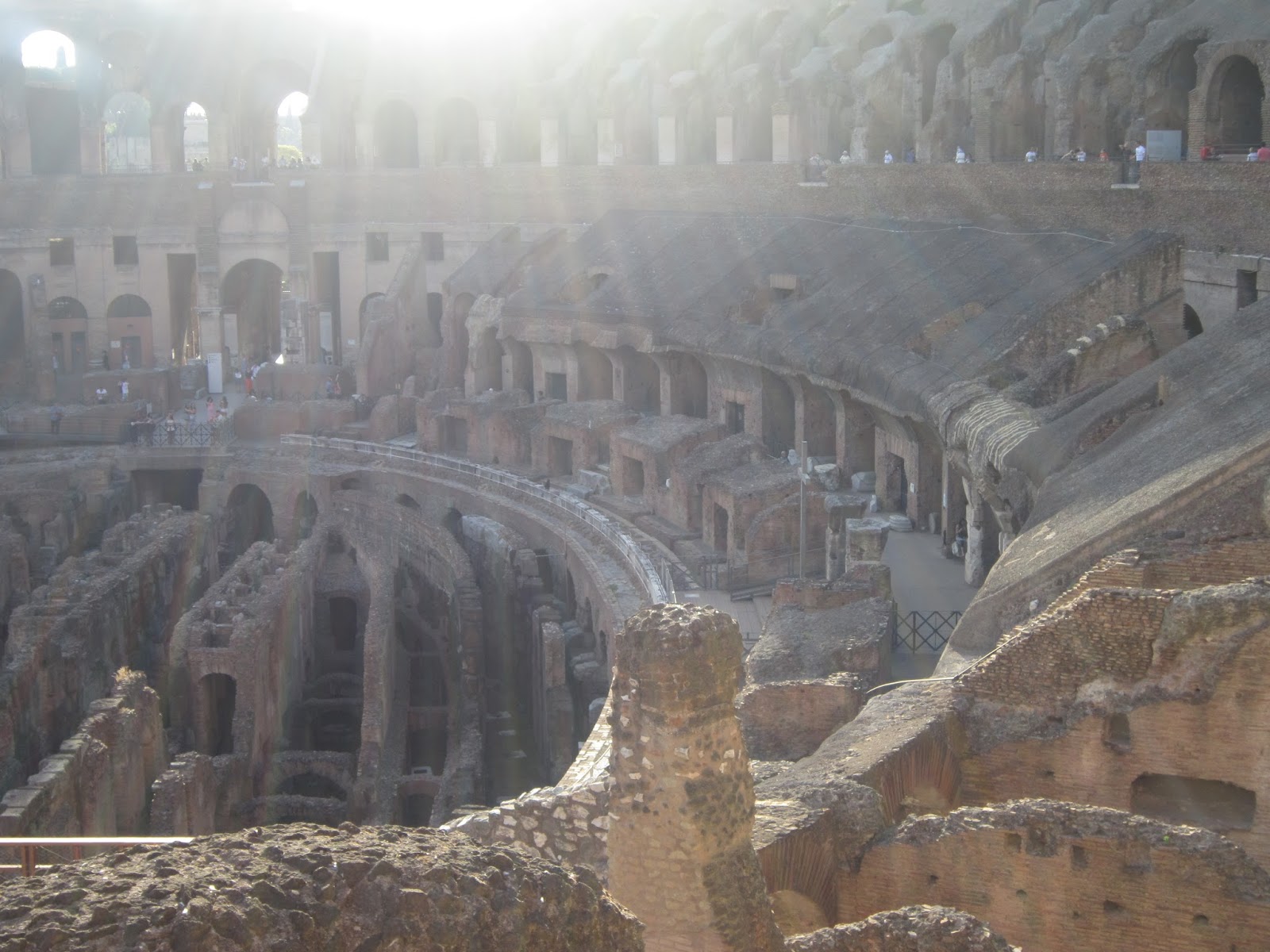
The Colosseum of Rome, known for its gladiator fights
Which today, is known as the land of lights.
It has an enormous underground circular base
The ruins of which still adorn the place.

So that's all I have got to say about Rome.
After all, I can only dream of it from home.
All I can do is persuade you to visit this scenic land
And while going, take me along, hand in hand.

Anthology of student poems written for 100 TPC


Thanks for visiting, Poetry Friday friends. If you have any questions or feedback for Menka, please leave them in the comments.

Enjoy this photo gallery from Rome. I hope Prachi has a chance to visit this city of wonders some day.

The Colosseum just before sunset.
Griffin doorknob in a Roman church

Modern art on the doors of
Santa Maria degli Angeli


Writerly sculpture at the Vatican museum

"Here there be dragons"
in the Vatican's Map Room