THE LAST FIFTH GRADE OF EMERSON ELEMENTARY

THE LAST FIFTH GRADE OF EMERSON ELEMENTARY
April 12, 2016
Showing posts with label elizabeth coatsworth. Show all posts

Monday, May 23, 2011

Teaching Stanzas

Did you know that the word stanza is Italian for room?

I love sharing this fact with children. Imagine, when you are reading a poem, the first stanza is like walking through the door into the entrance of the house. What room do you go into next? (For me, it's the kitchen.)

Each stanza of the poem is like its own room, with details to observe.

I use Newbery winner Elizabeth Coatsworth's poem, "Swift Things Are Beautiful," to practice stanzas with young writers. The structure of writing about opposites makes it easy for them to separate their ideas. My thanks to fellow Maryland State Arts Council teaching poet Roseann Singer for this lesson.

We start by generating a HUGE list of opposites on the board. Every year, students surprise me and come up with some new pairs. You can see that there's room for many different interpretations with this poem.

Gabe's response picks up on the description of the Coatsworth poem to create some powerful images:


Poet:     Gabe M.
Grade:  3
Teacher: Pruitt

Air and Under

In the air is thunder,
and a soaring sparrow.
In the sky it’s a nightmare,
but to a flying falcon,
it’s an electric light show.

Under the air is the
tortoise, large and trembling through.
Then there is an iguana in the iceless
blue. But in that sea where none can be
there is a mystery, that of the sea.


The following poet was listening carefully to the model poem, playing with Coatsworth's final line to create a beautiful final image:

Grade:  3
Teacher: Pruitt

 Small Things are Beautiful

Small things are beautiful:
rabbits and mice,
seeds and particles
that are very still.

Big things are beautiful:
trees and mansions
graceful elephants
and eagles that
glide through winds of power.


Daniel came up with a new topic -- cats and mice. He could have written simply about the differences between these two animals, but Daniel adds an element of action that takes this poem beyond "opposites," adding action and mystery.

Poet:     Daniel W.
Grade:  3
Teacher: Hilliard

The Cat Gets the Mouse

The cat gets the mouse.
The cat is sly, quick, brave, and
very, very sneaky!
Can he catch the mouse?

The mouse escapes!
Mice are fast, hyper and
surprising.
Though he is small, he is able to go
very, very fast!
Can the mouse escape?

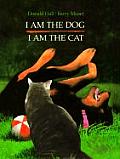
As a follow up to this lesson, I recommend that teachers share poet Donald Hall's wonderful picture book, I Am the Dog, I Am the Cat, with students. It models use of voice, as well as reinforcing the idea of opposites.

More opposites tomorrow, including a leather-wearing "Extreme" and his opposite, an educational-television obsessed "Boring."

Many thanks to the Northfield community, especially the third grade poets, for sharing their writing.

Tuesday, March 9, 2010

Opposites Poems

Writing opposites poems is one of the best ways to teach young one stanzas. My third grade students at Northfield Elementary are revising their poems, getting ready for Friday's Poets' Tea.

An aside -- stanza is the Italian word for room. When you read a poem, imagine it's like walking through the rooms of a house. Each stanza is a different room, with its own color scheme and knick-knacks, but still part of the whole home.

Opposites come in pairs, so our opposites poems have two parts -- two stanzas. The poetry comes from which details the author chooses, as Jack does with his amazing sensory imagery in "Day and Night."

Day and Night
by Jack S.

In the day, the sun is bright
and the birds soar gracefully, high in the sky.
As I look up in the air, the clouds look like ships battling.
The city is busy. The shopping spree is on.
There are so many cars on the road, I can barely get across.

The moon is so bright, shining down upon my little head.
Bats fly brave out in the dark, open night.
The stars in the sky reflecting off my eyes.
Not a word is heard in my ears as the city grows quiet.
The roads are scarce, not a car in sight.
As you can see, day and night are so different, yet both have
one thing in common. They are both so pretty.

You can find my full lesson on opposites poems here. The model poem is Elizabeth Coatsworth's "Swift Things Are Beautiful." Here's a nice clip of a child reading the poem.

In looking for a photo of bats, I came across these guys all wrapped up in little sleeping bags. Is that the cutest? You can read about these orphaned night-flyers and the Queensland animal shelter that rescued them here.

If you'd like more opposites poems to share with children, check out Donald Hall's book, "I Am the Dog, I Am the Cat." There are also several fun versions of Richard Wilbur's opposites/riddle poems.

Tomorrow, I'll be posting Pocket Poems by Northfield third graders. Be prepared -- we'll be letting our imaginations run wild!