THE LAST FIFTH GRADE OF EMERSON ELEMENTARY

THE LAST FIFTH GRADE OF EMERSON ELEMENTARY
April 12, 2016
Showing posts with label opposites poems. Show all posts

Thursday, May 28, 2015

In Residence: Opposite Poems

Happy Poetry Friday!
Who's hosting this week's
Poetry Friday party?
It's one of our sound poets!
Margaret Simon
of Reflections on the Teche.

I have a lot to celebrate this week.

Tomorrow, our son will graduate from high school. I'm so excited about sharing Robbie's milestone with family and friends. Of course, there will be cake.

On Monday, I fly to Salerno, Italy for the 100 Thousand Poets for Change international conference. Poets from more than 30 countries will be in attendance. I promise to bring back lots of great information for a future Poetry Friday.

Before that, let's check in with the Northfield third grade poets. They were working on their opposite poems. You'll find links to the opposite poem lesson at yesterday's post.

Taking the blog stage are poets Andrew V., Matthew L., Nathan W., Aly A., and Joanna B.

Andrew V.

Delicious and Disgusting

Delicious food is great: the smell
of milk chocolate is tempting me to eat
faster, the candy tastes so good in my mouth,
the ice cream is so cold on a hot summer
day, the ham is so warm, and the sandwich tastes so good
on the inside with the bread outside.

Disgusting food is horrible: sweet
potatoes aren’t supposed to be sweet so I hate
them, carrots are too hard or too soft, tomatoes are
way too soft, spinach is not filling, and kale
doesn’t have good texture.

Kale Apple Cake, anyone?
From Veggie Desserts
Matthew L.

Baseball

I like being safe:
You could get hit by a pitch
or 4 balls, a walk,
or line drive to third that
brings you to first, or a
pop fly to the out field for
a double … or triple,
a slow HOME RUN, or four
run GRAND
SLAM as you slide into
home.

I hate being out:
Like three strikes, strike out!
Or the ball beats you to first …
or second … or third,
or you got tagged out from
the opposer’s glove
OR IT’S CAUGHT IN THE
AIR or a 2-out
DOUBLE PLAY
as I say darn

in this great
baseball game.

Matthew *really* wanted to write about baseball. I was impressed that he found a way to write an opposite poem about his favorite sport. Didn't you get caught up in the action with this poem?

Nathan W.

Teachers and Kids

Oh, man. Teachers
are so strict. They yell at so much.
They are so boring.
They make us sit in a chair all day.
They’re bossy and mean, but they can
also be nice and fun if you are good,
and they even sometimes let you have
extra recess.

Kids! Kids are awesome
and nice. They let you borrow stuff.
They are very funny. But they can be
annoying and loud and they
sometimes tease you and call you
names sometimes.

It often happens... student poets set out to write a teacher vs. student opposite poem. Along the way, they realize they have empathy for their teachers, and that kids are pretty complicated people.

Aly A.

The Wonderful Things about Day and Night

Day is wonderful.
I see things alive and clear.
I feel happy and free.
I play and explore and find
things I never saw before.
But when day ends…

Night is wonderful.
I feel like the world is asleep.
It is peaceful and quiet.
I hear the sounds of the night
like the owl hooting
and lightning bugs buzzing
and then I fall asleep.

Aly's poem reminds me of "Let Evening Come," a poem we often talk about during this lesson. There are lines from our model poem "Swift Things Are Beautiful" that read:

And slow things are beautiful.
The closing of day.

If you like this image, I recommend reading Jane Kenyon's "Let Evening Come."

Joanna B.

School Supplies

Messy is bad.
If you are messy, you can’t find things.
You might have bent folders, notebooks all over,
broken pencils, and binders shoved in your desk.
All of that is bad.

If you are neat, you might have an organized
school box, larger things on the bottom and smaller
things on top, and your ruler not bent or broken.
You’ll be able to find your things. That’s what

I like and that’s the way I am.

There's a cake for that too, Joanna!
DIY project from What's Scrapping

Thank you to the Northfield ES community for hosting this annual residency. I appreciate having permission to share the third graders' poems. Readers, the students love hearing feedback from you. Please leave a comment about our opposite poems.

When I get back from Italy, I'll share our final poetry workshop from Northfield: writing odes to our shoes.

In Residence is an ongoing series this month. If you missed previous posts:

First Student Responses: "Words in My Pet Goldfish," "Words in My Bed," "Words in My Life"
In Residence: Poetry Friday Words: Poems by Laura S., Jason Y., Jeffrey G., and Isa L.
In Residence: The Simile Zoo: Poems by Sabine S., Asher, Cecelia D., and Evelyn D.
In Residence: Day 2 in the Simile Zoo: Poems by Allie L., Makaela M., Parker P., Matthew L., Vincent T., Lila R., Naomi C., and Julia J.
In Residence: Due Stanze: Poems by Avery,  Setutsi, Jen, Anlan, Arushi, and Johanna.

In Residence: Due Stanze

Welcome back to Northfield Elementary, readers, where I am spending May as the poet-in-residence.


Throwback Thursday:
One of my favorite residency photos.
The third grade poets have practiced word choice (list poems) and figurative language (animal simile poems). Today, we are working building on the list poem and learning about stanzas.

The word "stanza" comes from the Italian word for room. Often, I start this lesson inviting the students on an imaginary walk through my house. They expect to see a plant, some pictures, and maybe a coat rack in the entrance way. There is probably a microwave, stove, and sink in the kitchen. Is there a bed in the kitchen? No! The kitchen is for cooking.


Is it so strange to have a bed in the kitchen?
Design Bug doesn't think so.

We talk about the way the rooms of a house are organized around the purpose of each room. So why are poems organized into "rooms"? Each stanza might have its own purpose or main idea--kind of like a paragraph in prose writing.

The simplest way to teach stanzas is writing opposite poems. You can find a full description of my workshop here.

And this post has a poem-walk of the model poem, "Swift Things Are Beautiful" by Elizabeth Coatsworth.

Now entering la stanza della poesia, please welcome poets Avery,  Setutsi, Jen, Anlan, Arushi, Johanna.


Avery I.

Students and Teachers

A teacher mentors:
She grades worksheets,
possibly creates and gives a test.
A story is what she reads to her students.
Teachers spend lunch alone planning lessons.

A student learns:
You contentedly do a worksheet.
Tests with a million questions may come your way.
A chapter books is read aloud to you.
Students happily eat in the cafeteria with their friends.

Setutsi A.

Good Weather and Bad Weather

Good weather is bright sunshine.
In the night time a beautiful sunset brightens
the sky and hides the moon. Cool, crisp
weather blowing the leaves f one side
to the next. That is when it is not too hot
and not too cold.

Bad weather is rainy dark days
with lightning roaring up in the clouds.
Cold, snowy days, with foggy weather so you
can’t see too well in the distance. Snow is
freezing on your cheeks and ears. It makes
them turn pink.

This rosy-cheeked cutie is graduating
from high school on Saturday.
Congratulations to our Robbie!

Jen T.

Imaginary and Real Animals

Imaginary things are cute.
Unicorns that fly high in the sky.
Dragons breathing fire to burn things down.
Invisible koalas soaring over the town with no one noticing them.
Fish that don’t need water to live.

And real things are cute.
Horses that go galloping through the forest
Birds flying in the sky looking for food.
Koalas climbing in the wild of the forest.
Fish roaming and exploring the ocean.

Anlan L.

Cute and Creepy Animals

Cute animals are cool:
The playing feeling in a dog. The sound
of a cat purring at me. The eyes of
a bird staring at me, and the fur of a hamster
I am stroking.

Creepy animals are cool:
The 8 eyes of a spider
staring at me strongly. The scary hiss
of a cobra. The claws of a lobster pinching loudly,
and the teeth of a shark going up and down.

Arushi A.

Wild and Tamed Animals

Many animals are wild.
Lions pounce on their victims.
Tigers roam around secretly.
Sharks can smell their prey from a mile away.
Eagles soar high above, always watching.

Many animals are tamed.
Dogs light up your mood when you’re sad.
Kittens cuddle up with you beside the fire.
Canaries chirp a sweet song in their cage.
Goldfish wait patiently for their food.

Johanna A.

Extinct and Alive Animals

Things that are extinct are supposed
to be that way, because how would you feel
if a Tyrannosaurus Rex was running around or Spinosaurus,
Gigantosaurus, and Carcharodontosaurus and their pointy
teeth everywhere.

Things that are alive are supposed
to be that way. Then how would you
feel if a rabbit, or deer, or bird, or dog running
around everywhere with their soft hurt.

Read more about Carcharodontosaurus

Thank you to the Northfield ES community for hosting this annual residency. I appreciate having permission to share the third graders' poems.

Readers, the students love hearing feedback from you. Please leave a comment about our opposite poems.

Look for more opposite poems from the Northfield third grade poets tomorrow, Poetry Friday. Addio, poeti!

In Residence is an ongoing series this month. If you missed previous posts:

First Student Responses: "Words in My Pet Goldfish," "Words in My Bed," "Words in My Life"
In Residence: Poetry Friday Words: Poems by Laura S., Jason Y., Jeffrey G., and Isa L.
In Residence: The Simile Zoo: Poems by Sabine S., Asher, Cecelia D., and Evelyn D.
In Residence: Day 2 in the Simile Zoo: Poems by Allie L., Makaela M., Parker P., Matthew L., Vincent T., Lila R., Naomi C., and Julia J.

Thursday, November 13, 2014

Poetry Friday in Residence: Opposite Poems

This month, I am in residence at Manor Woods Elementary School. I'm having a blast reading and writing poetry with the third grade students and their teachers. Thanks to the MWES PTA and the Howard County Arts Council for funding our workshops!

We're celebrating Poetry Friday
at Keri Recommends this week.
Click through to join the party!

Last week, I shared the onomatopoeia lesson I use during poetry residencies.

Part 1 of the lesson -- with student responses -- is here.
Part 2 of the lesson -- with more poems by third graders -- is here.

Today, let's focus on opposite poems. I use this workshop to teach stanzas, a way for young writers to organize their thoughts and begin playing around with white space on the page.

The model poem I use is "Swift Things Are Beautiful," by Newbery Award-winning author Elizabeth Coatsworth. This is a rich poem for the third graders to discuss. You can find my poem walk, where we look at "Swift Things Are Beautiful" line by line, at this post.

On to the third grade poets! You will see that some of us aren't ready to stop celebrating Halloween.

Cute and Scary
by Julia W.

I like cute things:
baby chicks hopping in your hand,
little puppies jumping up an down,
little kittens meowing away,
babies saying "goo goo ga ga."

I don't like scary things:
monsters that scare you away,
vampires with blood dripping,
witches that are cackling,
and zombies that are dead.

Hot and Cold
by Ryan M.

Hot things make me warm.
A fire breaks out.
The sun warms me up.
A volcano erupts. Lava burns into rock.

The stove makes steam.
Cold things are beautiful.
I can see my footsteps in the snow.
I pull an icicle down from the roof.
I see a polar bear growling.
I can also see a penguin
taking care of its eggs.

Animals
by Claire B.

Some animals are slow.
Snails crawl on a path.
Turtles walk on the beach.
Hippos stomp in hot places.

Some animals are fast.
Tigers run in Africa.
Birds flap in the day.
Owls fly at night.

Visible, Not Visible
by Cade A.

Visible things are beautiful:
a dog running through a meadow,
a bright sunshine in the morning,
a house with glittering snow,
a big chocolate fudge sundae
waiting to be eaten.

But invisible things can be useful.
The wind guiding you through the forest.
Taste telling you if you like something or not.
Tape holding your mistakes together.
Smell guiding you to a cake
with three layers.


I have taught this lesson many times. It always excites me when a young poet like Cade finds a creative new opposite to write about, one that none of my past students has come up with before.

Thanks to the Manor Woods for giving me permission to share these poems. Monday is our Poets' Tea. Stop by and read some food poems to help us celebrate.

Thursday, May 16, 2013

Sad Things Are Good: More Opposites from Third Grade

Available at Amazon.
One of my favorite books of opposite poems is by the poet Richard Wilbur. The story is that opposites were a dinnertime game Wilbur played with his children. One person would think of a word (sometimes outlandish). The rest of the family would try to come up with the best opposite.

Wilbur's poems, often rhyming, offer hysterical insight into these opposites. In one of my favorites, he makes a case for "pillow" as the natural opposite for "armadillo."

Another book I recommend when the students are working on opposite poems is I Am the Dog, I Am the Cat by poet Donald Hall.

At Goodreads.
This wonderful read-aloud not only teaches about opposites (dog vs. cat), but illustrates use of voice in poetry. The poems are spoken alternately by the dog and the cat, laying out the similarities and differences between the two sometime-friends, sometime-enemies.

Here are the last of the opposite poems by the Northfield third graders. Thanks to their families and teachers for allowing me to post their work!

A lesson plan for the opposite poem workshop is posted here.

It's not surprising -- this being May, school is not quite winding down yet -- that Jenny expresses how different home and school can feel in late spring.


Jenny D.

Home, School

Home: I can watch TV.
I can make some crafts.
Kristen can play with me.
I might get some clay.
I’ll eat my cake half.
We’ll play all day.

School: Tons of writing.
Tons of reading.
So much fighting.
Cannot play.
Have a meeting.
Homework all day.

A few years ago, a student proposed "Real and Imaginary" when we were brainstorming opposites. For the fantasy readers in the classroom like Minuk, this makes a great topic. I love the way the poem closes on a powerful, real animal.


Minuk H.

Real Animals and Fake Animals

Griffins are big.
Pegasus flies high.
Unicorns are beautiful.
Giants stomp really hard.
Dragons shoot fire.

Dogs bark loud.
Cats play with yarn.
Snakes attack fast.
Frogs hoppity hop.
Lions are king of the jungle.

Lion-013-2048x2048
Visit the Animal Crossing Wiki page for kids.
I was intrigued by the topic of Vivian's second stanza. Is it possible to feel sad and good at the same time? She chooses some beautiful images to prove the point.

Vivian H.

Happy Things Are Great

Happy things are great:
Like blooming flowers in spring
Or animals like deer
Beautiful nature everywhere
And trees beside rippling water

Sometimes sad things are good too:
Like rain pounding on my roof
Or falling leaves meaning it’s time to bundle up
Oh, I wish I was bee sting proof

Tomorrow is Poetry Friday. I'll have some Northfield portrait poems to share. You won't believe how far the third graders' imaginations roam when they're pretending to be someone else.


Friday, May 11, 2012

Teaching Stanzas Part 2

Happy Poetry Friday!

I've been working on opposites poems with the Northfield third graders. Earlier, we did some warm ups and learned about stanzas (see the post here). Today, let's walk through the model poem.

First, we take a quick look at the poems. Since we're working on opposites, and opposites come in pairs, the third graders are expecting two parts, or stanzas.

Swift Things Are Beautiful
Swift things are beautiful:
Swallows and deer,
And lightning that falls
Bright-veined and clear,
Rivers and meteors, (5)
Wind in the wheat,
The strong-withered horse,
The runner's sure feet.
And slow things are beautiful:
The closing of day, (10)
The pause of the wave
That curves downward to spray,
The ember that crumbles,
The opening flower,
And the ox that moves on (15)
In the quiet of power.
When I was studying how to teach, our Methods professor encouraged us to write a list of  "hoped-for answers" to prepare for a poem discussion.

I ask the children to volunteer favorite lines, things that sound good to their ears, or part that feel confusing. Usually, they cover my "hoped-for answers" list and add new ideas.

Line 2: Children do find this line beautiful, thought not all know what a swallow is. I share that the bird is known for being an acrobatic flier. (And they frequent a nearby park.)

Lines 3-4: This section always comes up! I ask the students to look at the back of their hands or inside of their wrists. If we look at the veins there, we can see how they are shaped like lightning. What an amazing comparison the author is making.

Line 6: We talk about the idea that wind is invisible, it is the effect of wind moving that we can see. The wind can transform a field of grass into an undulating ocean.

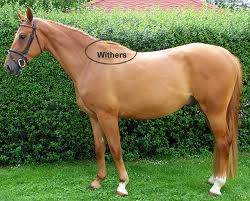
Line 7: I  had to look up "withered" myself. Here, I have everyone give him or herself a pat on the back. The spot that we're patting, between the shoulder blades, would be our withers if we were horses.
horse-pros.com
Line 8: The idea is that "sure feet" communicates the smooth motion of an experienced runner. This line doesn't always come up, in which case I skip it.

Line 9: Later, I'll encourage the poets to use Coatsworth's strategy here. While this is not a refrain, the opening lines of each stanza are similar and introduce the topic.

Line 10: It's a thrill to have a nine-year-old boy or girl describe why s/he loves this line. This year, one of the boys described the image of the shifting shadows as the sun goes down. I sometimes offer Jane Kenyon's poem "Let Evening Come" as an extension for this line.

Line 11-12: For years, I've been talking with children about a crashing wave and how it pauses for a second or two as it crests. This year, Ms. Grim offered a new interpretation -- the tunnel of a wave that surfers ride.

Line 13: Often, we need to define ember. Most children are familiar with campfires or fireplace fires, so we can talk about the beautiful, glowing coals and how they slowly crumble to ash as the fire goes out.

Lines 15-16: We spend the most time on these two lines. I remind the students that a poet often puts the most important idea near the end of the poem, because it's the thought the reader is left with. We define "ox" if needed. I ask them what they think about the idea of something slow being powerful. Our culture usually equates power with speed -- race cars, rocket ships, the cheetah. Can a slow thing be powerful?

Before we read the poem one more time (to hear it as a whole after discussing its parts), I ask the children if they can find the overall theme. Yes, we are talking about fast and slow, but it is fast and slow things in nature that the poem focuses on. They get it!

This sounds like a lot when I write it up. But the children are so quick -- we usually cover all of these ideas in a fifteen minute discussion.

Before we move on to writing our own opposites poems, I'll usually read a few student samples from past years. Those who like to brainstorm can use a simple T-chart for this poem, listing three or more examples for each opposite.

Thanks again to Northfield's staff and families for sharing today's poems!

chewinggumfacts.com
Treats
by Colin E.

Sweet things are very tasty!
Like bubble gum popping in my  mouth
And Popsicles melting on my hand and falling on the floor.
And caramel melting in my mouth and tasting oh, so sweet.


And sour things are tasty too!
Like Sweet Tarts that make me pucker just like sour lemonade.
And Sour Patch Kids that me me twitch
  and make me beg for more.
At last the Green Apples, which my brother really hates
but they just make me feel so happy and let me smile with glee.

This next student poem is challenging because of the subject matter. However, it ends on a note of hope that I find beautiful. (I had asked the student to think of something he might contrast with the tanks in stanza one.)

War & Peace

Wars are bad...
fighting with other people
people dying and families crying
long black and bloody days of war
tanks are destroying after
destroying other things

Peace is good...
non-fighting with other people
people that are free and nobody's dying
no black and bloody days with other people
hang-gliders are peacefully flying

Summer and Winter
by Emily H.

Summer is fun:
You swim at the pool
Slap a volleyball at the beach
Surfing on a bright green wave
My aunt Michelle's boathouse is so fun
While we wolf down ice cream before it melts

Winter is fun, too:
Having snowball fights
We're bundled up with hats and gloves
Sledding over crisp and clear snow
The snow angels are beautiful
Christmas brings us presents
While we sip warm hot chocolate
After we eat the cold snow.

Randy's poem tells a story.

Land & Water
by Randy S.

Let's take a splash.
Manatees swim freely through the waters of Crystal River.
Dolphins make a splash into the ocean blue.
Octopi bounce around in the Marina.
Look a jellyfish. Ouch, it stung me!
Hopefully that crab doesn't get influenced.
I should probably scream 'cause here comes a shark.

We're back on land.
Now I'm back on land, blue sky overhead.
Green grass swaying in the wind.
I have to get back home to tend to my cockapoo.
Squirrels flying through the trees as I walk up the driveway.
Boo-boo comes flying to the door.
I'm glad to be home.

Today's Poetry Friday post is wonderful Irene Latham -- stop by for more poetry links.