Yesterday, author Charles Rammelkamp visited to talk about the postcard tradition he shares with his twin brother.
Today, I've got postcard and poem #22. If you've been following the project, you know that I hit a creative wall with the last five or six poems.
A lot of the most recent poems were light verse. Some were clever. Some were ridiculous. I wasn't totally satisfied with them, but I had gotten them done and moved ahead.
That ended with postcard #22. It is a painting, "Memories of the Bitter Past," by Betty LaDuke.
UPDATE: Betty LaDuke was kind enough to give me permission to post her painting!
The card came to me as part of the 30 Contemporary Women Artists book published by Pomegranate.
UPDATE: Betty LaDuke was kind enough to give me permission to post her painting!
 |
| Memories of the Bitter Past, Betty LaDuke, posted with permission of the artist. |
Attempt 1:

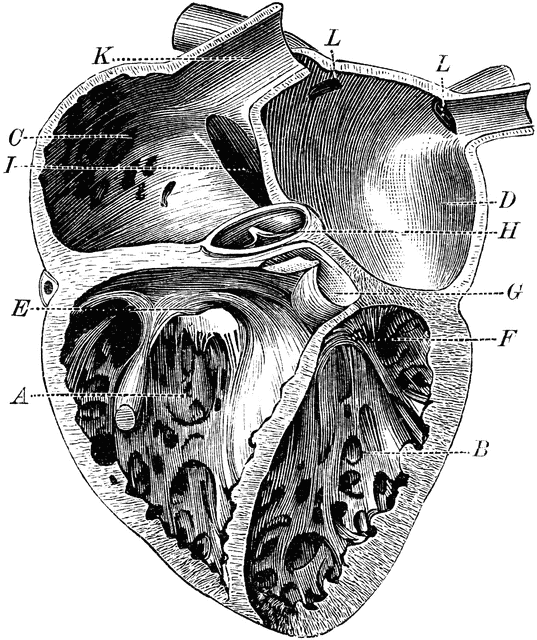
I had an idea, triggered by the word "bitter." What if the heart functioned like a tongue, with different tastes or sections devoted to the emotional flavors: sweet, sour, salty (tears), bitter? The poem was coming as a direct address:
My love, what if
the heart was like a tongue
its quadrants mapped
each with its own
proclivities...
This (white paper) is from my bedside notebook.
Attempt 2:

I came downstairs, grabbed a yellow pad, got a little rhyme action going.
In school I learned
how tastes divide
the tongue, a continent
of countries, sour
sweet. The quadrants
of the heart need
such a map, I want
to know each chamber
and its beat.
It's obvious from all the crossing out that I could not sustain this line of thinking/rhyme/rhythm. I tried doing some research about the structure of the heart.
 |
| Draft 3 with teeny diagram of the blood flowing through the heart. |
And, as you can see from the second "stanza" (actually a reboot), I suddenly realized that what I had on my hands was a wannabe sonnet.
In school, I learned how tastes divide the tongue,
a continent of flavors, sour and sweet.
The content of the heart need such a map.
I want to know each chamber and its beat.
Hooray! I know where the poem is heading. Now, I can get to work.
Attempt 3:
 |
| Sonnet is not working. I try short lines again. |
Or not. I will spare you the: complaining to my husband, tearing out of hair, stomping around the kitchen, eating crunchy things very loudly.
I decided to start over. I opened The Essential Rumi and read a few poems. I began again.
Attempt 4 (Revised):
Every Flavor
After Rumi
A
bitterness for what is past
travels
through two chambers of the heart
and
then your lungs.
You
unlock the door, expecting the heart
to
shrink like a mealy apple
when
it learns who is visiting.
Dishes
for every taste are served at this inn,
every
flavor: salty, sweet, sour and bitter.
Your ventricle welcomes each guest,
Your ventricle welcomes each guest,
sweeps
him back out again,
saying, “Come again, come again” or
saying, “Come again, come again” or
“That
one won’t be back.”
Your
atrium is the hearth
blazing
and crumbling,
blazing
and crumbling.
If it were always embers
or
always a roaring fire,
the
memory-guests would stay
they
would talk all night,
drinking
and eating delicacies,
you
would be consumed.
by Laura Shovan
Postcard
Information:
30
Contemporary Women Artists
Betty LaDuke (American, b. 1933)
Betty LaDuke (American, b. 1933)
Memories
of the Bitter Past, 1979. Acrylic, 68 x 54 in.
©
1979 Betty LaDuke
Pomegranate
● Box 808022 ● Petaluma, CA 94975
This is the second time I've written a poem mimicking Rumi's style. The first is "The Parable of the Piano Bench," which will appear in this spring's edition of Seminary Ridge Review.
I hesitate to call this a breakthrough poem, but I do feel as thought I worked past that creative block. Magical realism sometimes appears in my poems. I'm still learning how to listen -- how to entertain and develop a wild idea when one walks through the wall.
 |


