THE LAST FIFTH GRADE OF EMERSON ELEMENTARY

THE LAST FIFTH GRADE OF EMERSON ELEMENTARY
April 12, 2016
Showing posts with label original poem. Show all posts

Wednesday, April 29, 2015

NPM 2015: What Are You Wearing? It's a Wrap Dress

Tomorrow, we say farewell to National Poetry Month 2015. Thanks to all of you for following what's been an amazing series on poems about clothes. Why clothes? Read this post.


National Poetry Month may be ending,
but you can eat poetry anytime.
It's as easy as opening a book.
We've looked at everything from underwear to topcoats, from rainbow skirts to muddied white sneakers. I've learned so much from all of the guest bloggers. 

Clothes -- and poems about them can:

help us express our individual style,
make us feel connected to the person the article of clothing belonged to,
represent a season, a mood, or a longing,
be descriptive of a battlefield or a shared experience between parents and children,
create a sense of comfort and warmth,
be intimate, because they are held close to our bodies in a way that few other things are.

I am beginning a third grade poetry residency. This week, we worked on list poems. Naomi Shihab Nye's "Words in My Pillow" from the anthology Falling Down the Page was our model.
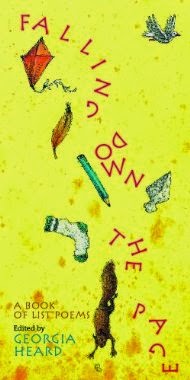

You'll find "Words in My Pillow"
in this anthology of list poems
from MacMillan.
Several students wrote a "Words in My Closet" poem. I decided to join them.

Words in My Closet
by Laura Shovan
after Naomi Shihab Nye

I keep words in my closet.
Words that make me look good.

CASHMERE
QUIRKY
PONCHO

No one sees them
until I put them on.
but I know what's in there--

DENIM
SNEAKERS
PURPLE
BATHROBE
STRIPES
ELEGANCE

UNDERWEAR is in there.
JELLYFISH SOCKS are in there.

The words plan outfits together
when I'm not looking.

This BLOUSE and that SKIRT
like hanging around together.
FLOWERS brighten up my closet.
RAVENS cheer "TOUCHDOWN!"
in my closet.

My friends the words
know better than I do
what fits me well.

Next week, I'll begin posting some of the third grader's list poems. They have been doing an awesome job.

Thanks again to all of the wonderful bloggers who let us into their poetry closets this month.


A skirt-full of flowers from me to you.
You'll find this and more floral skirts
at Polyvore.
ICYMI: In our poetry closet, you will find...

UPDATE: Thanks to all those who have posted a clothing poem on your home blogs and shared a link to AuthorAmok.

Read Irene Latham's ekphrastic poem "Yellow Dress."
Read about Carol Varsalona's vintage pantaloons!

And be sure to stop at Space City Scribes. The blogging team out of Houston (thus their cool name) is hosting Poetry Friday this week.


*Your suggested clothing poem prompt for Friday, May 1: Personification
If an article of clothing could talk, what stories would it tell? Whether it's a thrift store find, or an item for your closet, let your clothes speak for themselves. Has that black fedora traveled with you to Mexico? Was your daughter wearing that dress on her first day of kindergarten? Have your white Keds become mud-streaked from your hours spent in the garden? Maybe your jeans are tired of being patched and mended and would love to be retired.

Send your poems any time. I'll post original work and recommended poems on Friday.

Thursday, October 16, 2014

Poetry Friday: Golden Shovels

Thanks to everyone who tried writing a Golden Shovel poem with me last week.

To review: the Golden Shovel is a poetic form invented by MacArthur genius award winner Terrance Hayes. You can read his original Golden Shovel here. Using a favorite poem by someone else as your starting off point, take the words of the first line or stanza (or any favorite line from the poem). Use those words in order as the end words for each line of your new poem.


I'm breaking out the glo-paint
for Michelle H. Barnes.
She's hosting Poetry Friday this week
at Today's Little Ditty.

The poems I'm featuring today--Golden Shovels by Linda Baie, Michelle H. Barnes, and my poem based on a William Carlos Williams favorite--describe autumn in their imagery and tone.

I have to agree with Joy's (who blogs at Poetry for Kids) comment on last week's post. One of the biggest challenges in writing a Golden Shovel is dealing with line breaks. When the form requires ending on a word such as "from," "a," or "the," how does the poet make the line feel unforced? Not easy. Beginning with a haiku or other noun-rich poem, as Joy suggested, is good advice if you want to try a Golden Shovel.

Margaret Simon of Reflections on the Teche told me that poet Nikki Grimes ran a contest with this form. Although the contest is over, Grimes' explanation of the Golden Shovel is kid-friendly. Stop by her blog if you'd like to check it out and try it with your young writers.

Here is Linda Baie's contribution, followed by a few lines from her jumping-off poem, "Loss" by Carl Adamshick. Linda blogs at Teacher Dance.

The first line must be about the wind,
in October, I feel the lifting
of the trees, lighter now without the leaves,
slipping like babies turning from
the breast, into sleep, nestled in mother’s branches.


Linda Baie © All Rights Reserved


Loss
by Carl Adamshick

It is nice to be without answers
at the end of summer.
Wind lifting leaves from branches.

The moment laid down like something
in childhood and forgotten, until later,
when stumbled upon, we think:
this is where it was lost.

I'm amazed that Linda's poem has such a different feel from the original, even though she "found" a line of Adamshick's poem for her own piece, and both are set in autumn.

Michelle also chose a favorite line for the basis of her Golden Shovel. The words at the end of each line come from the third line of Adelaide Crapsey's "November Night." You can read "November Night" at the Poetry Foundation.

Fallen

Soft, mottled leaves, like
Grandma's hands, pause on the steps
at the threshold of 
memory. A subtle passing,
in, then out, like distant ghosts. 


© 2014 Michelle Heidenrich Barnes. All rights reserved.


I love the way the ghosts travel from Crapsey's poem into Michelle's original piece.

You can see me working overtime in my new Golden Shovel, trying to make the end-words feel natural. As a writing exercise, this stretched my thinking and took the poem to unexpected places.

Waterwheel
by Laura Shovan
after William Carlos Williams


Rain today, so
I’m not doing much.
Sad, how productivity depends
upon the weather. I put my feet up on
the hassock, read postcards signed by “A.”--
anonymous pen-pal, whose favorite ink is red.
Here is a card depicting a waterwheel
in Notogowa, another from the town of Barrow
in Alaska – photos glazed
with fingerprints of those they traveled with
to reach me in the rain.
These cards bear the mark of water,
smell of the perfume samples they sat beside
in my mailbox, nestled between the
magazines and a flock of dull envelopes, white
as a hen house full of chickens.

Funny... a white bird also appeared in my first Golden Shovel.  Enjoy William Carlos Williams reading, "The Red Wheelbarrow."


Ever since the 2013 Poetry Postcard project, I do have a friend with whom I exchange postcards. He's not anonymous and doesn't write in red ink, but, I'm always glad to receive a postcard from poet Charles Rammelkamp. (You can read about Charles' loves of postcards at this post from 2013.) The most recent one he sent was of Prince William, Duchess Kate Middleton, and Prince George. Maybe Charles remembered that my mother is British.

Thursday, October 9, 2014

Poetry Friday: Lunar Eclipse


Wednesday morning, 5:15 am. My son groans when I turn on the light in the hall. My daughter begs for five more minutes of sleep. Hubby is already in the shower.

I have five minutes. Five minutes is not enough time to finish that chapter of my book (SKIN HUNGER, by Kathleen Duey) or go back to sleep. It is the perfect amount of time for checking Facebook.

Tricia at The Miss Rumphius Effect
is too busy rounding up
Poetry Friday links to check Facebook.
When you have five minutes, stop by her blog.

Facebook is where how I found out about the lunar eclipse. Friends across the country were waking their children up early and heading outside to view the Earth's shadow pass across the moon. At our house, it was just another early school day.

But I put the kettle on, got out my star-gazing binoculars, and slipped outside while everyone else went about their morning. This is what I saw...

This week's eclipse was a Blood Moon,
named for its coppery color.
Photo: EarthSky.Org 
Before everyone left for school and work, a thin line of moon -- wearing its coppery cloak -- was setting, just above the dark tree line.

Later that day, I was reading the "Poetic Asides" column in Writer's Digest. Poet Terrance Hayes -- a recent MacArthur genius award winner -- has invented a new poetic from. Using a line or lines from a favorite poem, use each word (in the correct order) as an end word in your poem. It's called a golden shovel, named for Gwendolyn Brooks' poem "We Real Cool" -- the basis for a golden shovel poem written by Hayes.

Writing Prompt: Write a golden shovel of your own.
Post your poem in the comments (making note of the poet/title of the original) and I will round up all of our golden shovels next week.

I like what Writer's Digest columnist Robert Lee Brewer says about this form. He calls it "a fun mix of found poetry and pure invention."

To capture the slow eclipse in the midst of my family's busy morning, I used Robert Louis Stevenson's "The Moon," from A Child's Garden of Verses.

Here is my golden shovel, followed by Stevenson's poem. (The words of Stevenson's poem are in gray.)

Eclipse, 5 am
by Laura Shovan

After Robert Louis Stevenson

Dark October morning, the
Earth’s shadow sweeps the Moon,
dissolves its round cheeks until the Moon has
only an icy smile. Next, it is the sliver of a
snowy owl, mostly hidden, its white face
shrunk to one silver eyebrow. Cuplike,
it holds the Sun’s reflection in its feathers. The
owl swoops down when my kitchen clock
strikes six, finds its roost below the horizon. In
moments, sleepers will tumble down the
stairs, their school shoes clicking in the still-dark hall.


The Moon
by Robert Louis Stevenson

The moon has a face like the clock in the hall;
She shines on thieves on the garden wall,
On streets and fields and harbour quays,
And birdies asleep in the forks of the trees.

The squalling cat and the squeaking mouse,
The howling dog by the door of the house,
The bat that lies in bed at noon,
All love to be out by the light of the moon.

But all of the things that belong to the day
Cuddle to sleep to be out of her way;
And flowers and children close their eyes
Till up in the morning the sun shall arise.


Sunday, April 27, 2014

Source Poems: "Wild Geese"

For National Poetry Month 2014, I have invited 17 authors and poets to guest post about source poems. In this series of essays, each writer will describe a single poem's significance in his or her life.


Poet and educator Margaret Simon -- one of our Pantone Poetry Project regulars -- is today's guest blogger. Margaret blogs at Reflections on the Teche.

Margaret Simon
Words are the gift of poets, and Mary Oliver is a master. A good friend gave me one of the first poems I heard by Mary Oliver. At the time, I was struggling with a professional position. This was one teaching job that I thought was IT, the perfect one for me. Then the unimaginable happened. My administrator found me inadequate, not good enough.

In my contract, I was being forced to go back to college for math. At the time, I had completed a masters program in gifted, been a teacher-consultant for the National Writing Project for 10 years, and had taught for nearly 20 years. My whole body revolted. I knew without a doubt that I would never be able to be a passionate math teacher. And a part of me was deeply insulted that it wasn’t enough to be a passionate writing teacher. I quit. I didn’t sign the contract. But my spirit was devastated. I was not good enough, a failure.

Mary Oliver saved me.

“You do not have to be good.
You do not have to walk on your knees
for a hundred miles through the desert, repenting.
You only have to let the soft animal of your body

         love what it loves.”

The soft animal of my body fell in love again and again with this poem. Her words were more than a comfort; they empowered me. I could move on, be good again, and be a part of the world.

“Whoever you are, no matter how lonely,
the world offers itself to your imagination,
calls to you like the wild geese, harsh and exciting-
over and over announcing your place
in the family of things.
”

My dear husband asked, “What do you want to do?” He encouraged me to pursue a job that would fit me, one where I could teach what I love. I did find it. I have been happily teaching gifted elementary students for the last 7 years. Ironically, I do have to teach math sometimes, but I find a way to work in writing, too.

I still go back to Mary Oliver’s words over and over. I am an achiever, a do-gooder, never-say-no kind of person.  "Wild Geese" has taught me to honor the person I am and to be willing to make mistakes, to not always be perfect. I realize that no matter what, I am loved. And I can love what I love without excuses.

Wild Geese
by Mary Oliver
You do not have to be good.
You do not have to walk on your knees
for a hundred miles through the desert, repenting.
You only have to let the soft animal of your body
       love what it loves.
Tell me about despair, yours, and I will tell you mine.
Meanwhile the world goes on.
Meanwhile the sun and the clear pebbles of the rain
are moving across the landscapes,
over the prairies and the deep trees,
the mountains and the rivers.
Meanwhile the wild geese, high in the clean blue air,
are heading home again.
Read the rest at The Writer's Almanac.
Or watch Mary Oliver read the poem:
Knowing
            a response to “Wild Geese” by Mary Oliver

The moon glows in rings of light.
My soft body relaxes,
knowing
Jupiter is shining in the predawn sky
saying
You are enough.
You do not have to be good.
Love what you love.

Listen
to the train in the distance
shouting its presence
to the world.
Stop,
write a poem from your heart.
Wait
for the train to pass.

I stop to pay attention
to the fading full moon
and Jupiter and
the endless cars of this train.
I can become one
in the family
of things.

--Margaret Simon
italics indicate Mary Oliver’s words

Mary Oliver
From The Poetry Foundation
Margaret Simon is a Mississippi native who married into a Louisiana life. She lives on the Bayou Teche in New Iberia, Louisiana with her husband, Jeff. Their now empty nest once housed three daughters, Maggie, Katherine, and Martha. Margaret has been an elementary school teacher for 28 years, most recently teaching gifted students in Iberia Parish. She has published poems in the journal The Aurorean, and wrote a chapter about teaching poetry to young children for Women on Poetry published in 2012 by McFarland  & Company, Inc. Publishers. Border Press published her collection of poems with her father’s Christmas card art, Illuminate in fall of 2013 [featured at AuthorAmok here]. Blessen, a novel for young readers, was published in April 2012, also by Border Press. In her teaching profession, she has a Masters degree in Gifted Education and certification by the National Boards for Professional Teaching Standards. Margaret writes a blog regularly at http://reflectionsontheteche.wordpress.com.

Previous posts in this series:
Diane Mayr on a haiku by Basho
Shirley Brewer on "The Singers" by Eavan Boland
Renee LaTulippe on "Daddy" by Sylvia Plath

Thursday, June 20, 2013

Poetry Friday: Finicky Feline

Remember the great Poetry Postcard project of early 2013? Remember how I said, "Stop at the planned 44 poems? Heck no! I'm having too much fun."

That was until I met Postcard #49. It is a paper collage from a fine art postcard series, 30 Contemporary Women Artists. And it had me stumped for months.


Detail from Postcard 49.
See full information at the bottom of this post.
My first attempt was to describe the image. Although visual imagery is my habitual "way in" to a poem, I struggled. Describing this image was not easy. The postcard features two Keith Haring-style water nymphs (nude), carrying a spotted leopard (hammock-style) through a lily pond. And the provocative title, Post Coital -- I didn't need to see that.

I let that sit for several months while I was teaching. When I went back to the poem, there was one salvageable line: "They have spent all day eating white paper petals."


The petals and shadows of the water lily are a fitting
subject for the depth and layers of  collage art.
http://www.all-creatures.org/works/waterlily.html
Round two. Persona poem. I like persona poems! I teach persona poems (see some student examples here). Maybe that will work.

I tried the poem in the voice of one of the water nymphs. This draft was called "Cut Out Woman." See, I can write provocative titles, too. But the poem? Bleh.

That's when I threw the early drafts out, gave up trying to create a meaningful poem, and took my own advice. Remember this "points of entry" exercise?

With your postcard (or other prompt: object, idea, memory), jot down:

1. Visual image
2. A word or phrase that jumps out at you
3. An image using one of your other four senses (not visual)
4. Is there something to research?
5. A personal connection

One of these will lead you down the path to the poem.


Is your path to the poem free of obstacles.
Mine certainly wasn't! Look out for those pesky water nymphs.
Did it work for Postcard 49? You bet! I researched the etymology of the word "leopard" and  was rewarded with this juicy piece of information: it contains roots for both lion and panther. In ancient times, the leopard was considered to be a hybrid cat. What did the leopard think about that?

The Leopard


Leo is my lion stride.
I’m velvet paws and kingly-eyed.

Pard is panther’s sinewed gait.
I climb up trees. I watch and wait.

A hybrid beast, the ancients said,
as if I had an eagle’s head

and mere spots on my dappled coat,
where sun and shadows swim and float,

as if my grace could be defined
or catalogued by human mind.

Patience is a hunter’s work,
and silent is the leopard’s lurk.

by Laura Shovan

Postcard Information:
30 Contemporary Women Artists
Beverly Bigwood (American, b. 1952)
Post Coital, 1988. Paper collage, 27 x 45 in.


Pomegranate ● Box 808022 ● Petaluma, CA 94975

http://commons.wikimedia.org/wiki/File:Namibie_Etosha_Leopard_01edit.jpg
Beverly Bigwood's site is worth checking out. There's a cool collage portrait at this link: http://www.bigwoodart.com/gallery/commissioned-portraits/3936981

Have a wonderful Poetry Friday and happy Summer Solstice to all this evening! Today's host is Carol at Carol's Corner.