THE LAST FIFTH GRADE OF EMERSON ELEMENTARY

THE LAST FIFTH GRADE OF EMERSON ELEMENTARY
April 12, 2016
Showing posts with label how to discuss poetry with children. Show all posts

Tuesday, March 19, 2013

Poetry Madness

It's Round Two of March Madness Poetry.

The only hoops in this game are the ones children's poets jump through. In each round, organizer Ed DeCaria gives the "authletes" an assigned word. We have 36 hours to create a kid-friendly poem, using that word.

This brilliant bracket belongs to and is the creation of the technically astounding Ed DeCaria.

It's up to readers to decide who moves through the the next round of the tournament. Ed, an educator and poet, has this handy list of things to look for in a strong poem.

From Think Kid, Think!:

Things to Consider in Making a Choice:
  • How well the poem incorporates the authlete’s assigned word.
  • Technical elements: meter, rhyme, form, shape, and other poetic standards.
  • Creativity: wordplay, imagery, unusual approach, etc.
  • Subtle elements that make the whole greater than the sum of its parts.
  • Your overall response: emotional reaction such as admiration, tears, laughter, terror, or some indefinable feeling.
Teachers, if you are studying poetry with the class, Ed's five "things to consider" would make a great topic for discussion about why we like or don't like certain poems.

My word for this round was "speculate." The first thought that popped into my mind was, "speculate what's on my plate" -- maybe a mealtime poem.

I wrote three pages of notes for this poem.

Page 1: Speculating about what's on the plate.
If it's a school lunch, it could be Rib-B-Que or mystery meat.
At home, maybe its unidentifiable leftovers for dinner.

Page 2: more notes with potential-words Post-It.
In my word bank, I had related words, synonyms and rhyming words:

spectacle--both meanings
spectator
specter (a ghost in this poem?)
spectral
spectrum
speculate (with definition)
reason
think
deliberate
cogitate
speck
speckle
speak
speaker
ruminate: to must upon, meditate

Notice that the word "flatulate" does not appear anywhere on my list. Hold that thought.

I played around with a few lines before submitting. The "radioactive fleas" became "radioactive peas" to better integrate the poem's food theme.

As much as I liked the speaker's personality coming through in the line "That's why I'm being so dramatic. Some vegetables make me asthmatic," I chucked it. The poem was starting to feel like a string of one-liners. For that reason, I also added some enjambment.

You can read the final poem, "A Bargain," here: http://www.thinkkidthink.com/6-speculate-vs-3-rigged/

However, before I sent the poem in, I once again doubted myself and wrote a totally different poem.


Page 3: Another attempt.
The tournament is called March Madness
for good reason.

Whys

My brother complains,
          "Why must you always speculate about normal things.
          Grass it just green. There are stars in the sky.
          Does it matter why?"
It matters to me! I want to know
          if my skin absorbs light like a blade of grass
          why don't I turn green? And how can it be
          that atoms are in me, the grass and those faraway stars?

Laura Shovan

This poem was uniformally voted against by my husband, kid #1 and kid #2.

Remember the thought that I asked you to hold? The word speculate has some, let's call them interesting, rhymes. Which my very goofy parents quickly realized. They raced off to write their own "speculate" poems, rushing to see who could send me theirs first.

Mom's Poem

On dewy ground I perambulate,
Allowing my thoughts to fluctuate,
Now is the time to speculate,
On why I have to flatulate.

by Pauline Dickson and not Franklyn Dickson


Dad's Poem

I hesitate to speculate
About the impact to my fate
When we go to bed at eight
And all I do is flatulate!

By Franklyn Dickson

Growing up in my family, it would have
been useful to have this sign in the house.
I have no idea how to do fancy voting stuff on my blog like the set-up on Think Kid, Think. However, feel free to leave a comment about which fart poem you prefer.

And remember, you can never be too old to have embarrassing parents.

Take it away, George Carlin! He shares a few fart jokes in this kid-appropriate clip.

Friday, May 11, 2012

Teaching Stanzas Part 2

Happy Poetry Friday!

I've been working on opposites poems with the Northfield third graders. Earlier, we did some warm ups and learned about stanzas (see the post here). Today, let's walk through the model poem.

First, we take a quick look at the poems. Since we're working on opposites, and opposites come in pairs, the third graders are expecting two parts, or stanzas.

Swift Things Are Beautiful
Swift things are beautiful:
Swallows and deer,
And lightning that falls
Bright-veined and clear,
Rivers and meteors, (5)
Wind in the wheat,
The strong-withered horse,
The runner's sure feet.
And slow things are beautiful:
The closing of day, (10)
The pause of the wave
That curves downward to spray,
The ember that crumbles,
The opening flower,
And the ox that moves on (15)
In the quiet of power.
When I was studying how to teach, our Methods professor encouraged us to write a list of  "hoped-for answers" to prepare for a poem discussion.

I ask the children to volunteer favorite lines, things that sound good to their ears, or part that feel confusing. Usually, they cover my "hoped-for answers" list and add new ideas.

Line 2: Children do find this line beautiful, thought not all know what a swallow is. I share that the bird is known for being an acrobatic flier. (And they frequent a nearby park.)

Lines 3-4: This section always comes up! I ask the students to look at the back of their hands or inside of their wrists. If we look at the veins there, we can see how they are shaped like lightning. What an amazing comparison the author is making.

Line 6: We talk about the idea that wind is invisible, it is the effect of wind moving that we can see. The wind can transform a field of grass into an undulating ocean.

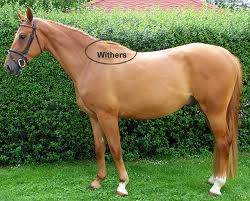
Line 7: I  had to look up "withered" myself. Here, I have everyone give him or herself a pat on the back. The spot that we're patting, between the shoulder blades, would be our withers if we were horses.
horse-pros.com
Line 8: The idea is that "sure feet" communicates the smooth motion of an experienced runner. This line doesn't always come up, in which case I skip it.

Line 9: Later, I'll encourage the poets to use Coatsworth's strategy here. While this is not a refrain, the opening lines of each stanza are similar and introduce the topic.

Line 10: It's a thrill to have a nine-year-old boy or girl describe why s/he loves this line. This year, one of the boys described the image of the shifting shadows as the sun goes down. I sometimes offer Jane Kenyon's poem "Let Evening Come" as an extension for this line.

Line 11-12: For years, I've been talking with children about a crashing wave and how it pauses for a second or two as it crests. This year, Ms. Grim offered a new interpretation -- the tunnel of a wave that surfers ride.

Line 13: Often, we need to define ember. Most children are familiar with campfires or fireplace fires, so we can talk about the beautiful, glowing coals and how they slowly crumble to ash as the fire goes out.

Lines 15-16: We spend the most time on these two lines. I remind the students that a poet often puts the most important idea near the end of the poem, because it's the thought the reader is left with. We define "ox" if needed. I ask them what they think about the idea of something slow being powerful. Our culture usually equates power with speed -- race cars, rocket ships, the cheetah. Can a slow thing be powerful?

Before we read the poem one more time (to hear it as a whole after discussing its parts), I ask the children if they can find the overall theme. Yes, we are talking about fast and slow, but it is fast and slow things in nature that the poem focuses on. They get it!

This sounds like a lot when I write it up. But the children are so quick -- we usually cover all of these ideas in a fifteen minute discussion.

Before we move on to writing our own opposites poems, I'll usually read a few student samples from past years. Those who like to brainstorm can use a simple T-chart for this poem, listing three or more examples for each opposite.

Thanks again to Northfield's staff and families for sharing today's poems!

chewinggumfacts.com
Treats
by Colin E.

Sweet things are very tasty!
Like bubble gum popping in my  mouth
And Popsicles melting on my hand and falling on the floor.
And caramel melting in my mouth and tasting oh, so sweet.


And sour things are tasty too!
Like Sweet Tarts that make me pucker just like sour lemonade.
And Sour Patch Kids that me me twitch
  and make me beg for more.
At last the Green Apples, which my brother really hates
but they just make me feel so happy and let me smile with glee.

This next student poem is challenging because of the subject matter. However, it ends on a note of hope that I find beautiful. (I had asked the student to think of something he might contrast with the tanks in stanza one.)

War & Peace

Wars are bad...
fighting with other people
people dying and families crying
long black and bloody days of war
tanks are destroying after
destroying other things

Peace is good...
non-fighting with other people
people that are free and nobody's dying
no black and bloody days with other people
hang-gliders are peacefully flying

Summer and Winter
by Emily H.

Summer is fun:
You swim at the pool
Slap a volleyball at the beach
Surfing on a bright green wave
My aunt Michelle's boathouse is so fun
While we wolf down ice cream before it melts

Winter is fun, too:
Having snowball fights
We're bundled up with hats and gloves
Sledding over crisp and clear snow
The snow angels are beautiful
Christmas brings us presents
While we sip warm hot chocolate
After we eat the cold snow.

Randy's poem tells a story.

Land & Water
by Randy S.

Let's take a splash.
Manatees swim freely through the waters of Crystal River.
Dolphins make a splash into the ocean blue.
Octopi bounce around in the Marina.
Look a jellyfish. Ouch, it stung me!
Hopefully that crab doesn't get influenced.
I should probably scream 'cause here comes a shark.

We're back on land.
Now I'm back on land, blue sky overhead.
Green grass swaying in the wind.
I have to get back home to tend to my cockapoo.
Squirrels flying through the trees as I walk up the driveway.
Boo-boo comes flying to the door.
I'm glad to be home.

Today's Poetry Friday post is wonderful Irene Latham -- stop by for more poetry links.