THE LAST FIFTH GRADE OF EMERSON ELEMENTARY

THE LAST FIFTH GRADE OF EMERSON ELEMENTARY
April 12, 2016
Showing posts with label poets in the schools. Show all posts

Thursday, June 6, 2013

Scenes from an Open House

Happy Poetry Friday and greetings from Gettysburg! This week, I'm attending the Gettysburg Review Conference for Writers, meeting great poets and studying with the wonderful Sidney Wade. (Check out her poem "Late.")

This week, my Northfield Poets celebrated their authorly accomplishments with an open house. Parents, grandparents, family and friends came to school to check out the great work.

Here are some photos from the event, along with a few more of the Northfield third graders' portrait poems.

Portrait poems on display in Ms. Hilliard's room.

Find the poem "The Adventurer" at this post.
Reading poems in Ms. Tavenner's room.
Poems on display in Ms. Pruitt's room.
Remember my last post, when we were talking about the way writing a portrait poem teaches compassion and empathy? I love how Gracie stepped out of her third grade experience to write this cosmopolitan, emotional poem.

Gracie F.

The Note to My Husband

With my hand on my chin, I think about my husband far, far away in California while I’m in Paris. I write to him, eat my lunch. I reach for my purse when I write to him how much I miss him. The waiter rushes past me to make a meal for a man in a top hat. I finish my note to my husband in California and I’m in Paris, France. Oh, how I miss him.

Although she wrote in response to the same work of art, the woman is Ellie's poem has a more active character. I wonder what the speaker is going to write about.

Ellie M.

Can’t Think of Anything

I’m sitting at a booth at the diner
On the corner of Mulberry Street.
I’ve had some wine, a whole glass in fact,
And still can’t think of anything.
My blonde hair in a bun, also
My black dress and lace cuffs.
Have to get the poem done
Before the ball.
A light bulb has gone off in my brain.
I think I’ll go pay the bill
And go home, but oh,
I just thought of something to write.

Phillip wrote in response to a Shonto Begay illustration that we've seen before. (The werewolf poems were among the most popular at our open  house.)

Phillip W.

Mysteries at Night

Night holds many mysteries
I am turning into a werewolf
It is midnight
I am not happy about it
I am changing fast
I was forced to be a werewolf
I will look for a meal
I will join a pack
I will howl at the moon
I will find a home
I will miss being a human
Now darkness is my friend
I sleep during the day
I have to go

I think the pack sees me.

And here is how my day ended, with gorgeous pink roses to add to the peonies from my garden. The smaller flowers are called Coral Bells.


Thanks for another great year of poetry, Northfield ES!

Today's Poetry Friday host is my dear friend Tabatha at The Opposite of Indifference. Have fun recharging your poetry batteries with some great offerings today.

Thursday, May 9, 2013

Third Grade Fibs

Last week, I taught the Northfield E.S. third graders how to fib.

How to write a fib, that is. We kicked off my annual poetry residency writing Fibonacci poems. The students loved the combination of math (we talked about the Fibonacci sequence and how it is derived from a mathematical formula), science (we looked at Fibonacci spirals in nature) and poetry (we figured out that a poem could follow the Fibonacci numbers by counting out syllables).

growing patterns cover
I use Sarah C. Campbell's book as a jumping off point for the Fibonacci lesson.
You can find my full Fibonacci lesson plan at this Fib post.

Here are some of the third graders' scientific poems. I like how Ethan combines the largeness of space with a small moment -- counting stars -- in his poem.

Ethan H.

Space
Stars
Planets
Some just found
Circling the sun
Counting the stars on a bright night

From http://www.destateparks.com/activities/stargazing/
Our local astronomy club is the Howard County Astronomical League.
They hold star gazing events for families.
Julian's weather-related Fibonacci poem tells a dramatic story.

Julian H.

Boom!
Whoosh!
Get down
Tornadoes
Go to the basement
Bring a radio and some food
Are we all here? One,  two, three, four, five. Good.
     We’re all here.
The tornado stopped but we’re trapped in the basement.
     Crack. Light. The police found us. We are safe.

From tornadofacts.com
Once we realized that dinosaurs are a scientific subject, Daniel was ready to write his poem.

Daniel C.

Dinosaur

Egg
Born
Reptile
Meat-eater
Hunting a Troodon
T-Rex are very dangerous

Image: Troodon formosus dinosaur
Learn about the Troodon at National Geographic.
And Zach was also interested in the power of the weather.

Zach B.

Hurricane

Rain
Hail
High winds
Powerful
Very deadly storm
Can destroy the whole ocean coast

Hurricanes form a Fibonacci spiral.
This is Super Storm Sandy at beforeitsnews.com
Want more fibs by kids? Read some here.

I'll post more third grade poems tomorrow for Poetry Friday, and that's no fib.

Friday, May 25, 2012

Poetry Friday: Mummy of Lady Teshat

It's a very happy Poetry Friday for me. By the time you read this, I will be in Florida, meeting my brand new nephew, Jagger Max. Jagger was born on April Fool's Day which, to anyone who knows my brother, shows that our newest family member already has a sense of poetic justice.

For the past week, I have been blogging about my portrait poem workshop. This is one of the most powerful lessons I do with kids. Encouraging students to write from a stranger's point of view works magic on their brains.

Today, I'll share a story from the poetry classroom, along with a student poem.

During April and May, I was in residence at Swansfield Elementary in Columbia, MD. On portrait poem day, the school's wonderful art teacher provided us with dozens of fine art posters. PTA President (and residency organizer) Jen Mallo put the artwork up all around the classroom. When Ms. Salazar's students walked in from lunch, there were walls full of faces looking back at them.

If you want to try the lesson (I've used it for grades 3 through HS), you can read my full portrait lesson here. After I shared the model portrait and poem, the fifth graders had a few minutes to select a work of art.

Malaika N. chose this:
Mummy Case of Lady Teshat
worldgallery.co.uk
I usually circulate around the room while students are writing. Malaika was quite absorbed in her work. When you read her poem, notice that it follows the structure I modeled. It begins with what you can see in the image -- the "facts" of the portrait. The point of departure, "what I can't see," begins with the word "Inside." From that moment, Malaika's imagination was working deep into the heart of the mummy.

Malaika stood and read this poem to her classmates as the period was ending. The room was silent. We all felt something amazing had happened. With words, Malaika made a strong emotional connection between herself, a 3,000-year-old mummy from approximately, and her audience.

Mummy of Lady Teshat
by Malaika N.

Mummified lady.
The casket resembles her.
Triangles and designs are all over.
She has dark hair and big eyes.
Inside, she screams to come out.
The gathering anger of 10,000 years
with a powerful kick will set her free.
Now she roams free.
She also roams unseen.
Now she is as weak as a baby bird.
She crumples to the ground.
Her dust finds it way back.
She is forever trapped in what she calls
the box of the afterlife.

Lady Teshat "lives" at the Minneapolis Institute of the Arts
I took a second to check in with Malaika before I left for the day. When a poet connects with an audience, the words take on energy as she speaks them. It is a physical sensation, hard to explain but unforgettable if you have experienced it (either as a poet or as an audience member).

"You felt that, didn't you?" I asked Malaika. She did. It was a transformational moment for her, but also for her classmates.

The Swansfield fifth graders have been revising and typing up their poems. I know Malaika worked on "Lady Teshat." I can't wait to see what she's done with the poem. You can read up on this work of art here.You can even share information about the mummy's recent CT scan with your science buffs.

Thank you to Malaika's family and to the Swansfield team for allowing me to share this poem.

Have a great Poetry Friday. I'll be posting more student poems next week. For now, please visit Linda at Teacher Dance for more poetry posts.

Wednesday, May 23, 2012

Portrait Poems Part 3

Last week, we looked at writing portrait poems with elementary schoolers.Part one of the lesson is here, where I introduce the concept of starting with "what I see" in a picture or newspaper photo, then adding "what I imagine" to extend the poem.

Part two of the lesson is here. It includes a model pairing of painting and poem by artist Shonto Begay.

Picasso is a great choice for the
portrait poem workshop. The image
invites storytelling.
In some schools, the art teacher will provide fine art portraits for the kids to choose from. I'll share some art-response portraits from fifth grade students tomorrow.

At Northfield Elementary, we like to display the portrait poems with their images. This means the children are asked to bring in newspaper or magazine clippings. Two rules: it has to be an image of a person, it should not be someone you know. We can bend this rule for celebrities. I don't like the students to write in response to photos of themselves or family. (See part one of the lesson for my reasoning.)

I recommend having extra photos. Newspaper clippings work best, because they often have a story built into the image. In finding good photos, look for expression in the face or body language, a person in action, or an interesting setting or "props" within the image.

When the students are ready to write, some like to use a T-chart for brainstorming: "I see" or "Facts" listed on one side, "I can't see" or "Imagination" on the other.

Kyle's portrait is also a narrative poem. I think he was inspired by our conversation about Shonto Begay's painting, "Down Highway 163." This poet has a natural sense of rhythm.

Run Away Slave
by Kyle S.

I've been working so hard
all day and night
but now I get to run
away from my king's sight.
I've been running through forests.
I've been running through fields.
I've been swimming through rivers.
Ouch, there's an eel.
And now I'm in a cave
with rocks and a boulder.
Oh NO! A dead end.
I must roll the rocks over.
Yay! Look, there's an exit
behind all of these rocks.
Out in the sun
and away from the locks.
Oh NO! It's my king
with the guards on his wing.
Now, the chase is on.


With a poet this advanced (even in third grade!) I feel comfortable making a comment on the eel line: "Does this funny line fit the tone of your poem?" Kyle will think that over when we revise.

Two students had the same photo -- a magazine ad showing a girl with a jar of fireflies. The class got to hear both poems. It was fascinating to see what different responses each poet came up with. Here is one (I added line breaks):

As She Sits
by Katie T.

As she sits on the stone fence,
her face gleams with light.
She held a jar
with rocks and plants plus light.
What is that glow in the jar?
Then fireflies shot out.
Her face lit up.
She watched them fly free.
In the darkness an owl hoots,
but she still watched.
The lid was in her hand.
A firefly landed on the lid.
The gold color shined bright
from the light.
The dark doesn't scare her.

animals.howstuffworks.com
The class talked about the owl -- an addition from Katie's imagination. There was no owl in the starting image.

Abby wrote in response to a post card I brought. It's a photo from a series of famous women. This one was of a statue of Sacagawea in Portland.

I See a Woman
by Abby Y.

I see a woman
reaching out
feeling her furry dress
with a stray coat
that's very gray.
The wind blowing
through her thick hair
with a baby on her back
standing there like she
is a frozen statue
not happy.

I read somewhere that Sacagawea is the subject of more U.S. statues than any other single person.
We'll look at some fifth grade portraits in response to fine art tomorrow.

Thursday, May 17, 2012

Portrait Poems Part 1

One of my students' favorite workshops -- not matter what grade they are in -- is on portrait poems.

The backbone of the lesson is simple. We use an image of a person to gather concrete facts, a list of things we know or can see. Then, we take the same image and let our imaginations go crazy as we make up a story about the person.
Try using images of people students don't know, magazine clippings
or portraits like this one of Ann Boleyn from englishhistory.net.
I like this exercise for several reasons. First, it teaches point of view on more than one level. As writers, many of the students will opt to write in the voice of the character. That makes the portrait poem something like acting. On the human level, writing a portrait poem teaches compassion. For some children, it's a stretch to imagine what the person in that photo might be thinking about or feeling. Writing a poem is a safe way to wonder about someone else's point of view.

The second lesson lesson that portrait poems teach is more subtle. Because we are taking what we can see (the facts) and then imagining what is unseen (what happens next, or the person's feelings), the portrait poem mirrors the process of writing poetry. Poets take concrete experiences and present them in a way that creates emotional impact or some kind of revelation. That's exactly what we do in a portrait poem.

I'm worth how much?!
I was working on portraits with the Northfield third graders earlier this month, when the Edvard Munch painting The Scream was in the news. A version of the painting (there are four) recently sold at auction for just under $120 million.

One of my students wrote a portrait painting on The Scream a few years ago.

Scream (Response to “The Scream”)
by James, Grade 4
The frightened man on
the bridge in black
he screams as the bridge
opens while he’s on it
in the front of the
bay, the boat goes
by and two people walk
toward him, helping him
off the bridge and running
as he yells to his
family as they scream
in horror as their son
almost died as the
bridge went up and down.

The Northfield third graders and I looked at The Scream and read the poem. We talked about which elements of the poem were facts (the frightened man, the bridge, the water, the boat, two people) and which were the poet's imagination (the drawbridge, the idea that the two people are helping, the family, the idea that he almost died).

This student model sets us up well for discussing another painting/poem pair, Shonto Begay's "Down Highway 163." You can find them in Begay's wonderful book, Navajo. 


We'll look at that tomorrow. For now, here are some third grade portrait poems.

Thanks to Northfield's family and staff (and poets!) for allowing me to share these poems. You'll notice that some of the students have opted for one stanza on "what I see" and a separate stanza for "what I imagine," as in this first poem.

I See a Family

I see a family
playing on the sand
two small boys
walking through the water
the water is rushing up
and covering their feet.

Maybe the mom is worried
and scared.
The current might pull
her sons into the dark
cold sea.

Richard's poem is literally immersed in what the speaker of the poem is doing.
Splash
by Richard G.

Splash
arms flailing
legs kicking
having fun in the water
being almost weightless
and perfectly round
bubbles floating
to the surface
I don't realize how
much time passes by
and suddenly
I hear my dad
and mom say
It's time to go!

I love how Noah imagines the complex emotions of an astronaut -- talk about a different point of view than your own!

Untitled
by Noah H.

The man is very happy.
He finished his job
middle aged man
is forty years old,
is an astronaut.
Loved space.
A little dizzy.
Wants to go again.
Happy to see his
family. Happy to
go home.

It will be clear to you which famous landmark was in the photograph Alex wrote about.

Waving "Hello!"
by Alex N.

Foreigner kids
waving hello
to a statue of freedom.
Entering America.
Maybe they're happy.
They could be frightened.
England or France,
where are they from?
Children are waving because
they're entering
a new life and a new world.
They've traveled through storms
and the coldest of nights.
They're finally there.
Whew!
What a delight.

Look for the second half of the portrait poem lesson, including a "poem walk" through "Down Highway 163" tomorrow.

Friday, May 11, 2012

Teaching Stanzas Part 2

Happy Poetry Friday!

I've been working on opposites poems with the Northfield third graders. Earlier, we did some warm ups and learned about stanzas (see the post here). Today, let's walk through the model poem.

First, we take a quick look at the poems. Since we're working on opposites, and opposites come in pairs, the third graders are expecting two parts, or stanzas.

Swift Things Are Beautiful
Swift things are beautiful:
Swallows and deer,
And lightning that falls
Bright-veined and clear,
Rivers and meteors, (5)
Wind in the wheat,
The strong-withered horse,
The runner's sure feet.
And slow things are beautiful:
The closing of day, (10)
The pause of the wave
That curves downward to spray,
The ember that crumbles,
The opening flower,
And the ox that moves on (15)
In the quiet of power.
When I was studying how to teach, our Methods professor encouraged us to write a list of  "hoped-for answers" to prepare for a poem discussion.

I ask the children to volunteer favorite lines, things that sound good to their ears, or part that feel confusing. Usually, they cover my "hoped-for answers" list and add new ideas.

Line 2: Children do find this line beautiful, thought not all know what a swallow is. I share that the bird is known for being an acrobatic flier. (And they frequent a nearby park.)

Lines 3-4: This section always comes up! I ask the students to look at the back of their hands or inside of their wrists. If we look at the veins there, we can see how they are shaped like lightning. What an amazing comparison the author is making.

Line 6: We talk about the idea that wind is invisible, it is the effect of wind moving that we can see. The wind can transform a field of grass into an undulating ocean.

Line 7: I  had to look up "withered" myself. Here, I have everyone give him or herself a pat on the back. The spot that we're patting, between the shoulder blades, would be our withers if we were horses.
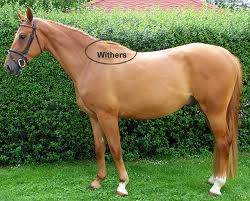
horse-pros.com
Line 8: The idea is that "sure feet" communicates the smooth motion of an experienced runner. This line doesn't always come up, in which case I skip it.

Line 9: Later, I'll encourage the poets to use Coatsworth's strategy here. While this is not a refrain, the opening lines of each stanza are similar and introduce the topic.

Line 10: It's a thrill to have a nine-year-old boy or girl describe why s/he loves this line. This year, one of the boys described the image of the shifting shadows as the sun goes down. I sometimes offer Jane Kenyon's poem "Let Evening Come" as an extension for this line.

Line 11-12: For years, I've been talking with children about a crashing wave and how it pauses for a second or two as it crests. This year, Ms. Grim offered a new interpretation -- the tunnel of a wave that surfers ride.

Line 13: Often, we need to define ember. Most children are familiar with campfires or fireplace fires, so we can talk about the beautiful, glowing coals and how they slowly crumble to ash as the fire goes out.

Lines 15-16: We spend the most time on these two lines. I remind the students that a poet often puts the most important idea near the end of the poem, because it's the thought the reader is left with. We define "ox" if needed. I ask them what they think about the idea of something slow being powerful. Our culture usually equates power with speed -- race cars, rocket ships, the cheetah. Can a slow thing be powerful?

Before we read the poem one more time (to hear it as a whole after discussing its parts), I ask the children if they can find the overall theme. Yes, we are talking about fast and slow, but it is fast and slow things in nature that the poem focuses on. They get it!

This sounds like a lot when I write it up. But the children are so quick -- we usually cover all of these ideas in a fifteen minute discussion.

Before we move on to writing our own opposites poems, I'll usually read a few student samples from past years. Those who like to brainstorm can use a simple T-chart for this poem, listing three or more examples for each opposite.

Thanks again to Northfield's staff and families for sharing today's poems!

chewinggumfacts.com
Treats
by Colin E.

Sweet things are very tasty!
Like bubble gum popping in my  mouth
And Popsicles melting on my hand and falling on the floor.
And caramel melting in my mouth and tasting oh, so sweet.


And sour things are tasty too!
Like Sweet Tarts that make me pucker just like sour lemonade.
And Sour Patch Kids that me me twitch
  and make me beg for more.
At last the Green Apples, which my brother really hates
but they just make me feel so happy and let me smile with glee.

This next student poem is challenging because of the subject matter. However, it ends on a note of hope that I find beautiful. (I had asked the student to think of something he might contrast with the tanks in stanza one.)

War & Peace

Wars are bad...
fighting with other people
people dying and families crying
long black and bloody days of war
tanks are destroying after
destroying other things

Peace is good...
non-fighting with other people
people that are free and nobody's dying
no black and bloody days with other people
hang-gliders are peacefully flying

Summer and Winter
by Emily H.

Summer is fun:
You swim at the pool
Slap a volleyball at the beach
Surfing on a bright green wave
My aunt Michelle's boathouse is so fun
While we wolf down ice cream before it melts

Winter is fun, too:
Having snowball fights
We're bundled up with hats and gloves
Sledding over crisp and clear snow
The snow angels are beautiful
Christmas brings us presents
While we sip warm hot chocolate
After we eat the cold snow.

Randy's poem tells a story.

Land & Water
by Randy S.

Let's take a splash.
Manatees swim freely through the waters of Crystal River.
Dolphins make a splash into the ocean blue.
Octopi bounce around in the Marina.
Look a jellyfish. Ouch, it stung me!
Hopefully that crab doesn't get influenced.
I should probably scream 'cause here comes a shark.

We're back on land.
Now I'm back on land, blue sky overhead.
Green grass swaying in the wind.
I have to get back home to tend to my cockapoo.
Squirrels flying through the trees as I walk up the driveway.
Boo-boo comes flying to the door.
I'm glad to be home.

Today's Poetry Friday post is wonderful Irene Latham -- stop by for more poetry links.